

The simplest way to keep things straight is this: a leave of absence is the broad category for any authorized time away from work, and FMLA is one specific, federally protected type of leave that falls under that umbrella.
The two terms are sometimes used interchangeably but they carry different meanings. When a request that should have been designated as FMLA gets mishandled, it can turn into a Department of Labor complaint or a costly lawsuit.
For example, the U.S. Department of Labor recovered $438,625 for two workers at an Alabama car manufacturer who were fired after requesting FMLA leave. According to the DOL, the employer treated their protected time off like ordinary absences, denying attendance bonuses and adding points under its attendance policy until both workers were terminated. The company had also failed to tell them they qualified for FMLA or to designate the time as FMLA leave. The lesson for HR is simple: treating protected leave as a routine absence can be an expensive mistake.
Knowing what FMLA is, when it applies, and how it sits inside your broader leave program is the foundation of a defensible, employee-friendly approach to time away from work.
In diesem Beitrag beantworten wir folgende Fragen:
What is a Leave of Absence?
A leave of absence is an authorized period away from work during which an employee keeps their employment status. It can be paid or unpaid, and it is granted under company policy, an employment contract, or federal, state, or local law.
Common types include:
- Medical leave
- Parental and bonding leave
- Personal leave
- Militärischer Urlaub
- Jury Duty and Witness Leave
- Bereavement
- Sabbaticals
- Personal Leaves of Absence
Some of these are required by law. Others are offered purely at the employer’s discretion to support and retain valued employees.
What is FMLA?
The Family and Medical Leave Act (FMLA), is a federal law that gives eligible employees up to 12 weeks of unpaid, job-protected leave in a 12-month period for qualifying family and medical reasons, with group health benefits maintained during the leave.
Who is covered and eligible
FMLA applies to employers with 50 or more employees within a 75-mile radius. An employee becomes eligible after working for the employer for at least 12 months (the months do not have to be consecutive) and logging at least 1,250 hours in the 12 months immediately before the leave begins.
For remote employees, the 75-mile radius is measured from the worksite they report to or receive assignments from, not from their home. The Department of Labor has clarified that a remote worker’s residence does not count as a worksite for this test. In practice, a remote employee is usually counted at the office their work is tied to, so a worker living far from any company location can still be FMLA-eligible if enough employees are based at, or reporting to, the worksite they report in to.
Qualifying reasons
These include the employee’s own serious health condition, bonding with a new child, caring for a family member with a serious health condition, and certain military family situations. Military caregiver leave can extend to 26 weeks.
What it guarantees
An employee returning from qualifying FMLA leave is entitled to the same or an equivalent position, and the employer must keep their health coverage in place throughout.
Leave of Absence vs. FMLA: The Key Differences
Most non-FMLA leaves of absence are dictated by state or local law, though employers can also provide leaves out of the goodness of their heart (and to be known as an employer of choice). FMLA is federally mandated and carries job protection that your policies cannot waive. Here is how they compare:
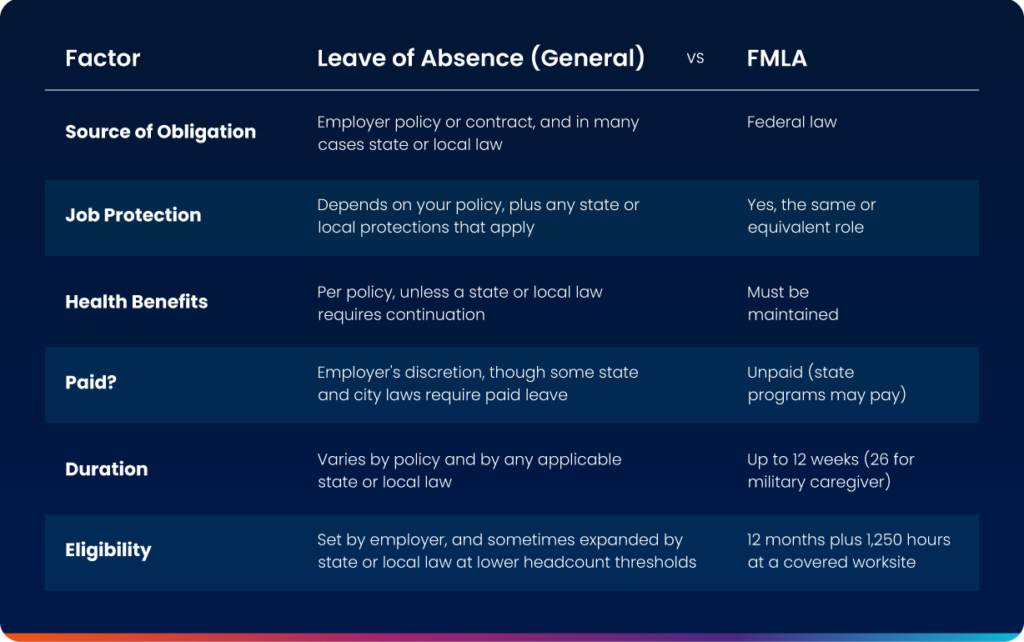
Notice that the leave of absence side is rarely as simple as whatever your policy says. State paid leave programs and city ordinances increasingly set their own rules for eligibility, pay, and job protection, and they often reach employers and employees that federal FMLA never touches. You may also need to consider whether employees are entitled to a leave under the ADA (Americans with Disability Act), PDA (Pregnancy Discrimination Act), or the PWFA (Pregnant Workers Fairness Act).
How Other Leaves of Absence and FMLA Overlap
Think of the old geometry rule: all squares are rectangles, but not all rectangles are squares. FMLA is the square, and leaves of absence are the rectangles. Every FMLA leave is a leave of absence, but plenty of leaves of absence are not FMLA. Because FMLA sits inside the broader category, the two of them (often) layer rather than compete.
Running leaves concurrently
When time off qualifies under FMLA, employers should designate it as FMLA even while the employee is also using PTO or short-term disability for the same period. When a leave qualifies as FMLA, it must be designated that way. This protects the employer’s tracking and the employee’s rights at the same time.
When FMLA runs out
A common scenario is an employee who exhausts 12 weeks of FMLA but still needs more time. At that point the protection has to come from somewhere else, such as your general leave-of-absence policy or a reasonable accommodation under the ADA.
Intermittent versus continuous leave
FMLA can be taken in one unbroken stretch or in smaller increments for medical treatment and recurring conditions. Intermittent leave is the hardest to administer correctly, since it has to be tracked in small blocks of time and reconciled against the employee’s total entitlement.
State Paid Leave and the Evolving Compliance Landscape
A growing number of states now run paid family and medical leave (PFML) programs. Recent public policy tracking counts 13 states and the District of Columbia with mandatory paid family and medical leave programs, with 10 more states offering voluntary programs through private insurance. Some of these protections reach smaller employers than the FMLA’s 50-employee threshold.
Because federal guidance and state programs keep evolving, review your handbook and leave policies on a regular schedule. This article is educational and is not legal advice. For high-risk situations, loop in employment counsel.
Häufig gestellte Fragen (FAQ)
Is FMLA a type of leave of absence?
Can an employee take a leave of absence without qualifying for FMLA?
Is a leave of absence paid?
Does a general leave of absence protect an employee's job?
Can FMLA and short-term disability run at the same time?
What happens when an employee exhausts their 12 weeks of FMLA?
Which employers are required to provide FMLA leave?
Do state paid leave laws apply to employers not covered by FMLA?
When the Rules Get Complicated, Reach Out to an HR Expert
Most leave disputes trace back to a few avoidable problems: failing to designate qualifying time as FMLA, miscounting intermittent hours, missing notice deadlines, or applying a single policy uniformly when employees sit in different states and cities. The hardest cases are rarely the textbook ones. They are the edge scenarios, like an employee who works remotely across state lines, a city ordinance that layers on top of a state program, or protected time that runs out in the middle of treatment.
If you find yourself stuck in one of those situations, it helps to be able to ask a real person. Mineral’s HR experts can talk through the tricky questions with you, including how overlapping federal, state, and local rules apply when you have employees spread across multiple states. You can learn more about working with our HR experts here.