
主要收获
- AI for legal departments is the use of language models, document processing, and workflow automation to handle high-volume legal work such as intake, drafting, invoice review, and legal holds. It delivers reliable results when it runs on a governed system of record, with human review of outputs.
- The most practical AI use cases in legal include document automation, matter intake and triage, invoice review and billing compliance, legal hold workflows, policy comparison, and cross-functional matter intelligence.
- Mitratech ARIES brings agentic AI capabilities into governed legal workflows, ensuring AI outputs are always subject to human review before being acted on, with a complete audit trail of every AI-assisted action.
- Mitratech InvoiceIQ delivers 97%+ invoice accuracy using AI to classify time entries, flag billing guideline violations, and identify rate errors, significantly reducing manual review time.
- Legal teams need a strong operational foundation before AI can deliver reliable value: structured data, standard processes, clear permissions, and a system of record that gives AI the right context.
- AI is not a replacement for legal operations software; it’s the intelligence layer embedded within it, turning governed matter, spend, and workflow data into actionable insight.
In-house legal teams are being asked to move faster, manage more risk, support more stakeholders, and respond to growing business demands, all without a matching increase in headcount.
That pressure is exactly why AI in legal is getting so much attention.
But for legal teams, this is not just a question of speed. It is also a question of trust. As more AI tools enter the market (including platforms like Claude, Harvey, CoPilot, etc.), legal leaders are being asked to figure out which use cases are actually useful, which require stronger governance, and how to adopt AI without creating new operational or compliance risk.
As Liz Lugones puts it, AI alone does not transform legal teams. How you apply it does. That is where the conversation is shifting.
The most practical legal teams are no longer asking, “How do we add AI?” They are asking, “What problem are we solving, what foundation do we need, and where can AI improve the way legal work already gets done?” That distinction matters.
When AI is layered into structured legal workflows, supported by reliable data, and governed appropriately, it can improve consistency and help legal teams operate with more visibility and control.
More importantly, it can deliver trusted, contextual insight that helps legal professionals guide strategy, inform decisions, and provide higher-value counsel to the business (without compromising judgment or control).
That is what AI in legal looks like in practice. It is not about replacing legal judgment. It is about giving legal teams better ways to capture information, move work, surface insight, and scale their impact.
本文内容:
What Does AI in Legal Actually Mean?
AI for legal departments is the use of language models, document processing, and workflow automation to handle high-volume legal work such as intake, drafting, invoice review, and legal holds. It delivers reliable results when it runs on a governed system of record, with human review of outputs.
AI in legal is not a single tool, and it is not the same thing as matter management, eBilling, contract lifecycle management, or document management. Those are the systems legal teams already rely on, and they serve as the foundation and sources of truth that AI depends on for trusted data. AI is the layer of intelligence that can sit within and across those systems, making them more useful by turning structured data into actionable insight and supporting better-informed legal decisions.
In practice, that can include:
- Large language models for summarization, drafting support, and natural-language search
- Intelligent document processing to extract and structure information from unstructured files
- AI-assisted analytics to identify patterns, anomalies, and trends across matters, invoices, contracts, or policies
- Workflow automation and agentic actions that help route work, trigger next steps, and reduce administrative effort
The most effective approach is not to treat AI as a separate experiment. It is to apply AI within the workflows where legal work is already happening.
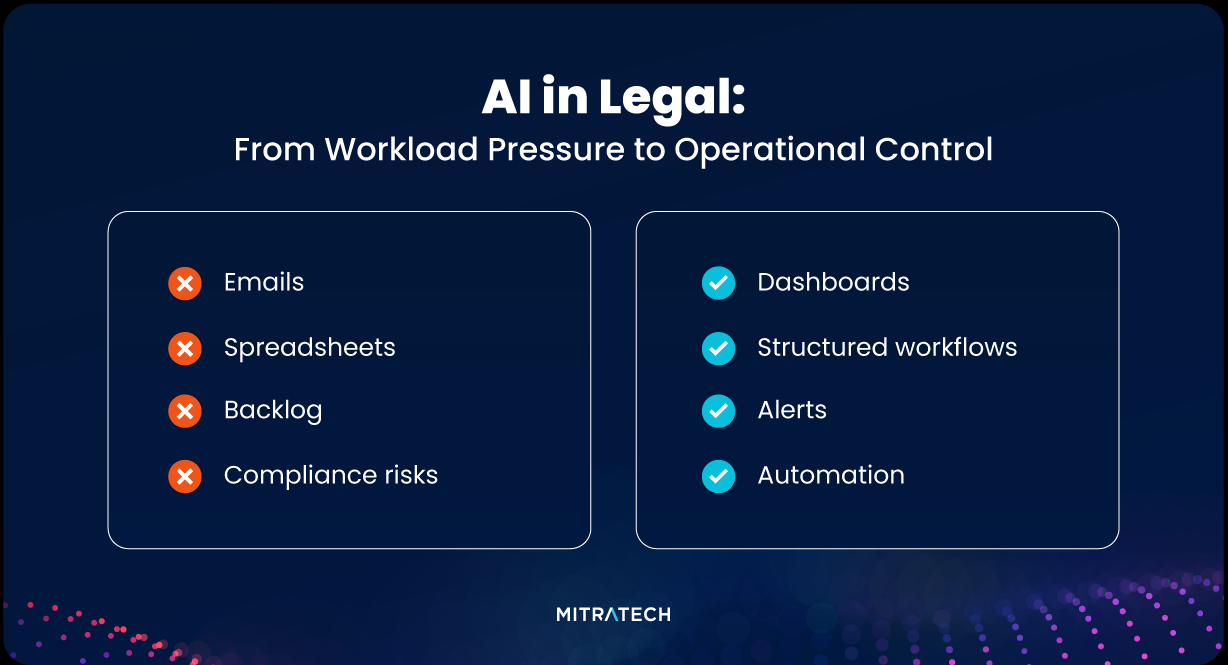
That is why foundation matters so much. If your data is fragmented, your processes are inconsistent, and your permissions are unclear, AI will amplify those weaknesses. If your legal operations are built on a governed system of record, with clean data, standard processes, and the right integrations, AI becomes far more useful and far more defensible.
For in-house legal teams, that is the real starting point.
Why the Foundation Comes Before the AI
One of the most important lessons from legal teams adopting AI today is that the technology only works as well as the operating environment around it.
Before AI can deliver useful outputs, legal teams need:
- A clear system of record for matters, spend, documents, and workflows
- Clean, structured data
- Strong permissions, masking, and access controls
- Standard operating procedures that define how work should happen
Without that groundwork, AI can produce answers that are incomplete, inconsistent, or difficult to trust.
But with it, AI becomes much more practical and valuable across legal operations. It can summarize a matter with the right context. It can analyze invoices against billing guidelines to flag errors and enforce compliance. It can also look across matters and spend data to deliver a more complete view of outside counsel performance.
Building that foundation is easier with a structure to follow. Our Go/No-Go Readiness Guide breaks down exactly what to check (like data mapping, access controls, vendor practices) before any AI use case goes live.
That broader view is where AI becomes especially powerful. Legal teams can compare law firms across matters, evaluating performance both quantitatively (spend, efficiency, outcomes) and qualitatively (responsiveness, adherence to guidelines, consistency). Instead of reviewing invoices in isolation, teams gain a connected understanding of how firms perform over time and across the portfolio.
The result is more informed, data-driven decision-making. Legal leaders can better manage outside counsel, allocate work more effectively, and align spend with performance — without relying on manual analysis or fragmented reporting.
Where AI in Legal is Delivering Practical Value
| Legal workflow | How AI helps | Operational value |
|---|---|---|
| 文档自动化 | Drafts from approved templates and structured inputs | Reduces manual drafting and improves consistency |
| Matter intake and triage | Extracts request details, categorizes issues, and routes work | Ensures consistent, trusted data intake |
| Matter creation and summaries | Turns unstructured files into cleaner matter records | Improves downstream reporting and searchability |
| Invoice review and spend analysis | Flags guideline violations, classifies entries, and surfaces trends | Strengthens spend control and enables better decisions on law firm management |
| Legal hold and eDiscovery readiness | Supports hold workflows, custodian tracking, and preservation steps | Improves defensibility and reduces manual follow-up |
| Policy and compliance workflows | Summarizes changes, compares versions, and routes approvals | Helps teams manage compliance more continuously |
| Cross-functional legal intelligence | Surfaces connected context across matters, contracts, and teams | Improves preparation and decision-making |
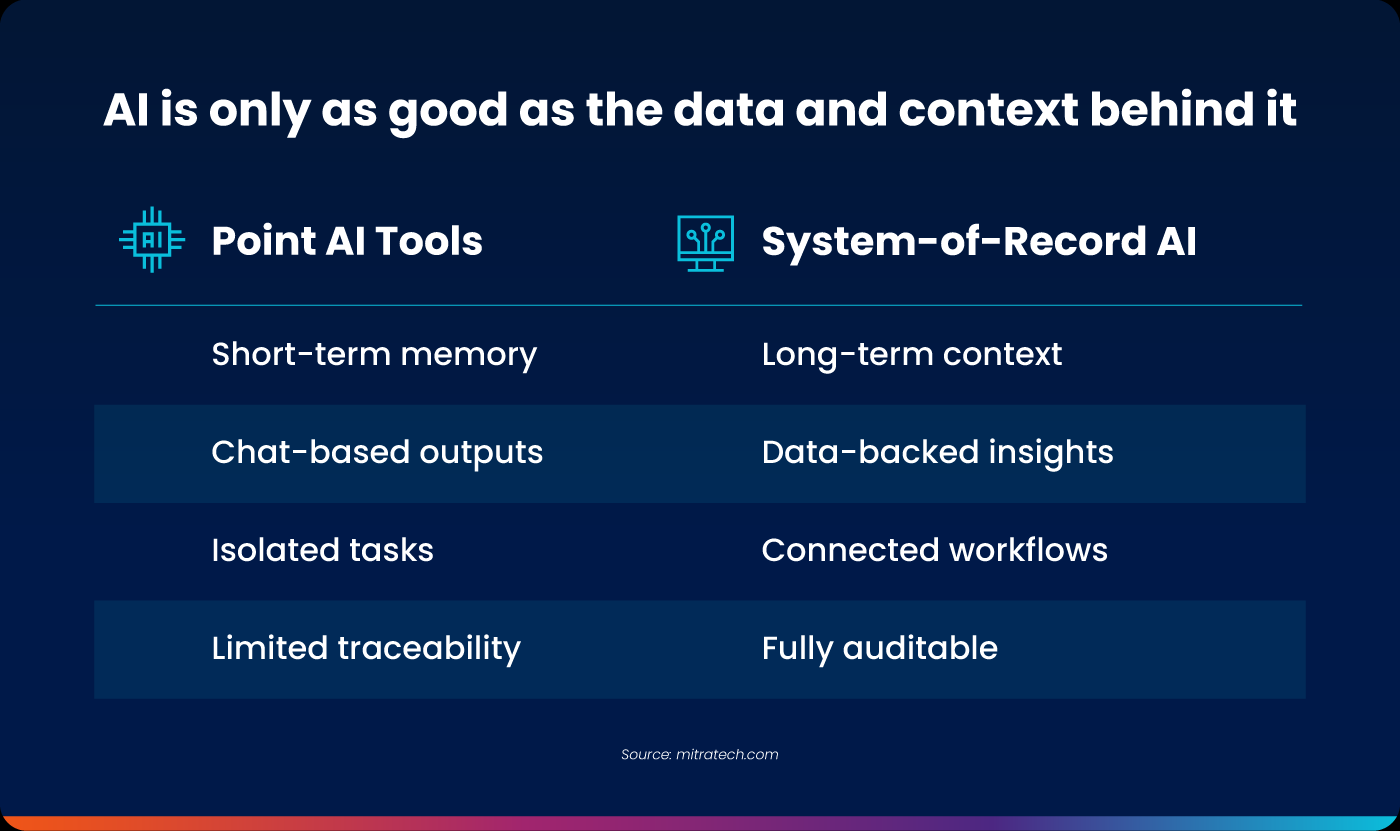
| Tool type | Best for | Limits | 实例 |
|---|---|---|---|
| General assistants | Drafting, summarizing, research support | No matter or spend context, limited audit trail | ChatGPT, Claude, Copilot |
| Legal-specific AI platforms | Contract review, legal research | Often separate from operational data | Harvey, Luminance |
| System-of-record AI | Intake, invoice review, matter insights, holds | Depends on clean underlying data | Mitratech ARIES, InvoiceIQ |
7 Practical AI Use Cases in Legal
-
Document Automation and Document Generation
Document automation remains one of the most practical and immediate applications of AI in legal operations.
Legal teams still spend too much time generating routine, high-volume documents such as NDAs, engagement letters, intake forms, standard agreements, and matter-related correspondence. In many organizations, the work itself is not legally complex. The friction comes from rekeying data, chasing approvals, formatting documents, and making sure the right language is used every time.
AI adds value here when combined with document automation and workflow.
That can include:
- Pulling approved data into templates from matter or intake systems
- Using guided interviews to generate the right document version
- Suggesting clauses or identifying missing information
- Routing drafts for approval based on business rules
- Keeping outputs consistent across teams and jurisdictions
The benefit is not that AI writes the legal work for you. The benefit is that routine drafting becomes faster, more standardized, and easier to govern.
For in-house teams, that means less time spent on repetitive document assembly and more time spent reviewing exceptions, advising the business, and focusing on higher-value work.
-
Matter Intake and Triage
Matter intake is one of the clearest examples of where AI can reduce operational drag.
In many legal departments, requests still arrive through email, chat, spreadsheets, or informal handoffs. That creates delays, inconsistent information, and limited visibility into workload.
AI can improve intake when paired with structured workflows. For example, teams can use AI to help:
- Extract key information from incoming emails or documents
- Identify the type of request or matter
- Suggest urgency, category, or risk level
- Route the matter to the right team or owner
- Draft an initial summary so the next person is not starting from scratch
This is especially useful when legal teams need to move quickly without sacrificing consistency.
The bigger value is not just speed. It is better intake data. When matters start cleaner, downstream reporting, staffing, spend tracking, and analytics improve too.
-
Matter Creation and Matter Insights
Once a matter is opened, AI can help legal teams turn unstructured information into something usable much faster.
A complaint, demand letter, investigation notice, or internal escalation often contains the information needed to start a matter, but someone still has to read it, extract the details, enter the data, and make sure the record is complete. AI can support this by helping legal teams:
- Extract parties, dates, jurisdictions, and key facts from source documents
- Populate matter fields automatically
- Generate matter summaries
- Surface recent activity and related matters
- Help new stakeholders get up to speed quickly
This is one of the most practical examples of AI as an operational amplifier. It does not replace legal review. It gives the team a stronger starting point.
And when matter data is more complete from the beginning, the department gets better reporting, better searchability, and better downstream insights.
-
Invoice Review and Legal Spend Management
Legal invoice review is another high-friction area where AI can create immediate value.
Manual review is time-consuming, and inconsistencies across firms make it hard to compare billing patterns, enforce guidelines, or identify where spend is drifting.
AI can support invoice review by helping teams:
- Classify time entries more consistently
- Flag billing guideline violations or anomalies
- Normalize line-item descriptions across firms
- Surface trends by firm, timekeeper, matter type, or activity code
- Identify where legal spend may warrant deeper review
This is especially valuable because legal teams are not just trying to process invoices faster. They are trying to understand what they are paying for, whether it aligns to expectations, and where there may be opportunities to improve performance or control costs.
And beyond individual invoices, AI can help connect spend data across matters to evaluate how outside counsel are performing over time. Legal teams can compare firms based on cost, efficiency, adherence to guidelines, and outcomes, creating a more complete view of performance.
That shift matters. Instead of reviewing invoices in isolation, legal leaders can make more informed decisions about which firms to retain, where to allocate work, and how to align spend with results.
-
Legal Hold and eDiscovery Readiness
AI is often discussed in the context of document review, but for in-house legal teams, one of the more important opportunities is earlier in the process.
Before review begins, legal teams need defensible legal hold, custodian tracking, preservation, and coordination across systems. If that upstream work is inconsistent, downstream discovery becomes riskier and harder to manage.
AI and automation can help by supporting:
- Faster hold creation based on templates and known matter context
- Better custodian identification and search
- Automated reminders and escalation workflows
- Improved tracking of acknowledgments and preservation status
- Integration with downstream eDiscovery tools
The point here is not just faster review. It is stronger defensibility. For high-risk legal work, speed without structure creates exposure. AI is most useful when it helps legal teams preserve that structure while reducing manual effort.
-
Policy, Compliance, and Internal Governance Workflows
Compliance work is often spread across policies, training, attestations, investigations, and internal reporting. That fragmentation makes it harder for legal teams to see what has changed, where risk is building, and which obligations are incomplete.
AI can help legal and compliance teams manage that complexity by supporting:
- Policy summarization
- Comparison of policy versions to highlight substantive changes
- Detection of redundant or overlapping policy content
- Routing policy exceptions and approvals
- Surfacing related training or attestation obligations
- Helping employees find the right guidance faster
This is where AI becomes especially useful when connected to workflow. It does not just tell you what changed. It helps move the right action to the right person.
For legal teams, that means less time coordinating administrative follow-up and more confidence that policy and compliance processes are actually being managed, not just documented.
-
Cross-Functional Legal Intelligence
One of the more strategic use cases for AI in legal is helping teams connect information that already exists across systems but is difficult to bring together quickly.
Legal, regulatory, litigation, contracts, government affairs, compliance, HR, and finance often operate in parallel. Even when information is captured somewhere, it is rarely easy to pull together in context.
AI can help legal teams ask better cross-functional questions, such as:
- What do we need to know before meeting with this regulator, customer, or vendor?
- What similar matters have we handled before?
- Which contracts, disputes, or policy issues are relevant here?
- What trends are emerging across jurisdictions, teams, or business units?
- How are our law firms performing across similar matters, and where are we seeing differences in cost, efficiency, or outcomes?
This is where AI becomes more than a productivity tool. It becomes a way to surface context that would otherwise take significant manual effort to assemble. But again, this only works when the underlying platform, integrations, permissions, and data architecture are in place. Without that, AI has nothing trustworthy to connect.
The Bigger Shift: From AI Features to Governed Legal Systems
Across all of these use cases, the pattern is the same. AI delivers the most value when it is:
- Applied to a clear operational problem
- Layered into existing legal workflows
- Connected to reliable, structured data
- Governed by the right permissions, policies, and processes
That is why the conversation in legal is changing.
The real opportunity is not to bolt AI onto disconnected tools. It is to create an environment where legal work is structured enough, visible enough, and connected enough for AI to support it responsibly.
For in-house teams, that is the practical path forward. Start with the workflows that generate the most friction. Standardize the process. Improve the data. Connect the systems. Then apply AI where it can remove administrative burden, improve consistency, or surface useful insight. That is how legal teams make AI useful.
How to Measure Whether AI Is Working
Rather than judging AI by adoption or usage stats, legal departments should track outcome metrics tied to day-to-day throughput: intake-to-assignment time (how quickly a new matter gets routed to the right owner), invoice review hours (time staff spend per invoice before approval), guideline exception rate (the share of invoices flagged for billing-guideline violations or rate errors), outside counsel spend variance (actual vs. budgeted spend by firm or matter type), and document turnaround time (cycle time from request to finalized document). Tracked consistently before and after deployment, these five give a clear read on whether AI is actually removing friction or just adding another tool to the stack.
On substantiated results, Mitratech has publicly reported that clients using its AI-powered InvoiceIQ invoice review achieve 97%+ invoice accuracy along with significant reductions in manual review time. More broadly, Mitratech has cited up to 80% time savings on manual administrative tasks and double-digit reductions in outside counsel spend across its customer base, translating to millions in annual savings redirected toward strategic work.
How to Evaluate Legal AI Vendors (7 questions)
- Where does the data live, and is it used to train models?
- Are outputs reviewable, with an audit trail?
- Does it respect matter-level permissions?
- Which systems does it integrate with?
- How is accuracy measured and reported?
- What does implementation require from legal ops?
- How does it handle privilege and confidentiality?
常见问题
How is AI used in legal departments?
What are some common AI use cases in legal?
Is AI in legal the same thing as legal operations software?
What do legal teams need before adopting AI?
What benefits does AI provide to in-house legal teams?
What challenges should legal teams expect when adopting AI?
How should legal teams get started with AI?
How do you evaluate an AI vendor for a legal team?
Is it safe to use generative AI with confidential legal data?
Ready to put AI to work? Start with the right framework.
Download our practical checklist to define your use case, manage risk, and keep human governance at the center of every AI implementation.
Get the Framework