
Legal operations has a positioning problem that no software can fix.
In 2026, legal ops teams are expected to own vendor risk, enforce billing guidelines, and shape contract policy. Work that sits squarely at the intersection of legal, finance, and procurement. But in most organizations, those three functions still operate in silos, with different systems, different metrics, and no shared accountability for the outcomes they all affect.
Building those cross-functional relationships is the work that most legal ops guides skip. This one won’t.
(For the technical implementation, including how to actually connect your systems and build the integrations that make these partnerships operational, see Part 2 of this series.)
In this Article:
- The Evolving Legal Operations Role in 2026
- Why These Relationships Are Hard to Build
- What a Real Legal Ops–Finance–Procurement Partnership Looks Like
- Bringing Finance and Procurement Into Your Legal Tech Roadmap
- The Hardest Part: Changing How People Work, Not Just How Systems Connect
- Measuring Cross-Functional Partnership Value
- Frequently Asked Questions
The Evolving Legal Operations Role in 2026
Legal operations has quietly moved from support function to organizational connective tissue. The decisions that carry the most regulatory and financial risk (like vendor onboarding, contract execution, spend authorization) now touch legal, finance, and procurement simultaneously. Legal ops leaders are increasingly expected to hold that intersection together.
But ‘expected to’ and ’empowered to’ are different things.
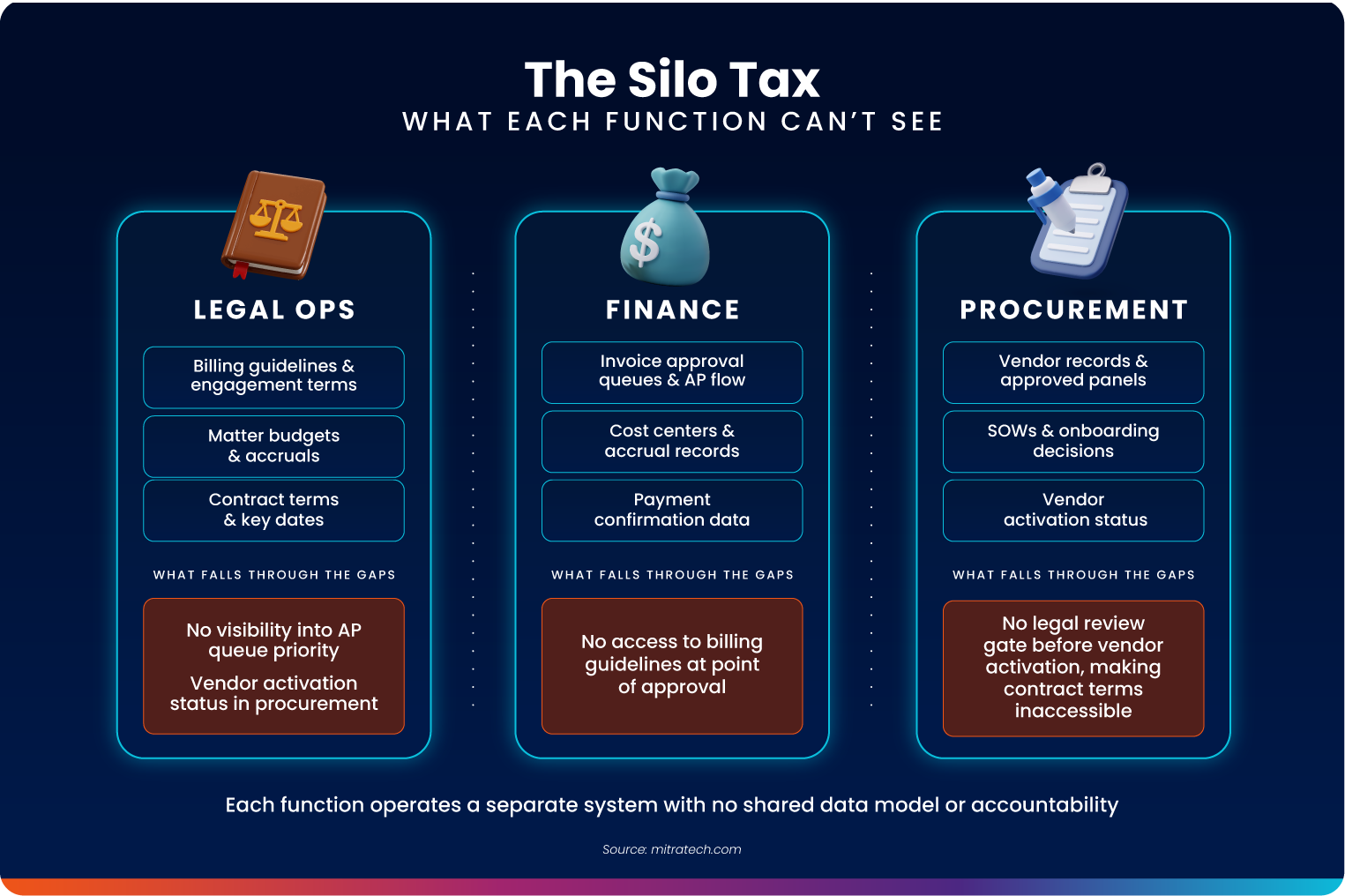
In practice, many legal ops teams are doing enterprise-level work without enterprise-level relationships. They’re managing vendor risk without a seat in procurement’s onboarding process. They’re enforcing billing guidelines without visibility into how finance prioritizes invoice queues. They’re setting contract policy without input into the technology decisions that determine how contracts get executed.
The gap isn’t knowledge. It’s integration; organizational rather than technical.
Why These Relationships Are Hard to Build
Finance and procurement have their own mandates, their own systems, and their own definitions of ‘compliance.’ When legal ops shows up asking for shared workflows or data access, it can feel to other departments like scope creep rather than collaboration.
A few structural reasons this happens:
Different languages for the same concepts
Legal talks about matters, engagements, and billing guidelines. Finance talks about cost centers, accruals, and purchase orders. Procurement talks about vendor records, SOWs, and approved supplier lists. These often refer to the same underlying relationships and obligations, but because they’re named differently and live in different systems, the people managing them can’t easily see they’re working on the same problem.
No shared ownership of cross-functional outcomes
When an invoice gets approved that shouldn’t have been, whose failure is it? Legal ops might say billing guidelines weren’t enforced. Finance might say the reviewer didn’t have access to engagement terms. Procurement might say the vendor was already approved and their process worked fine. Without shared metrics and shared accountability, everyone is right and nothing changes.
Technology decisions get made without legal in the room
Procurement picks a new vendor management platform. Finance selects an AP automation tool. Legal learns about it after implementation, when it’s too late to influence the data model or the approval workflow. This is one of the most common (and most avoidable) breakdowns in cross-functional collaboration.
What a Real Legal Ops–Finance–Procurement Partnership Looks Like
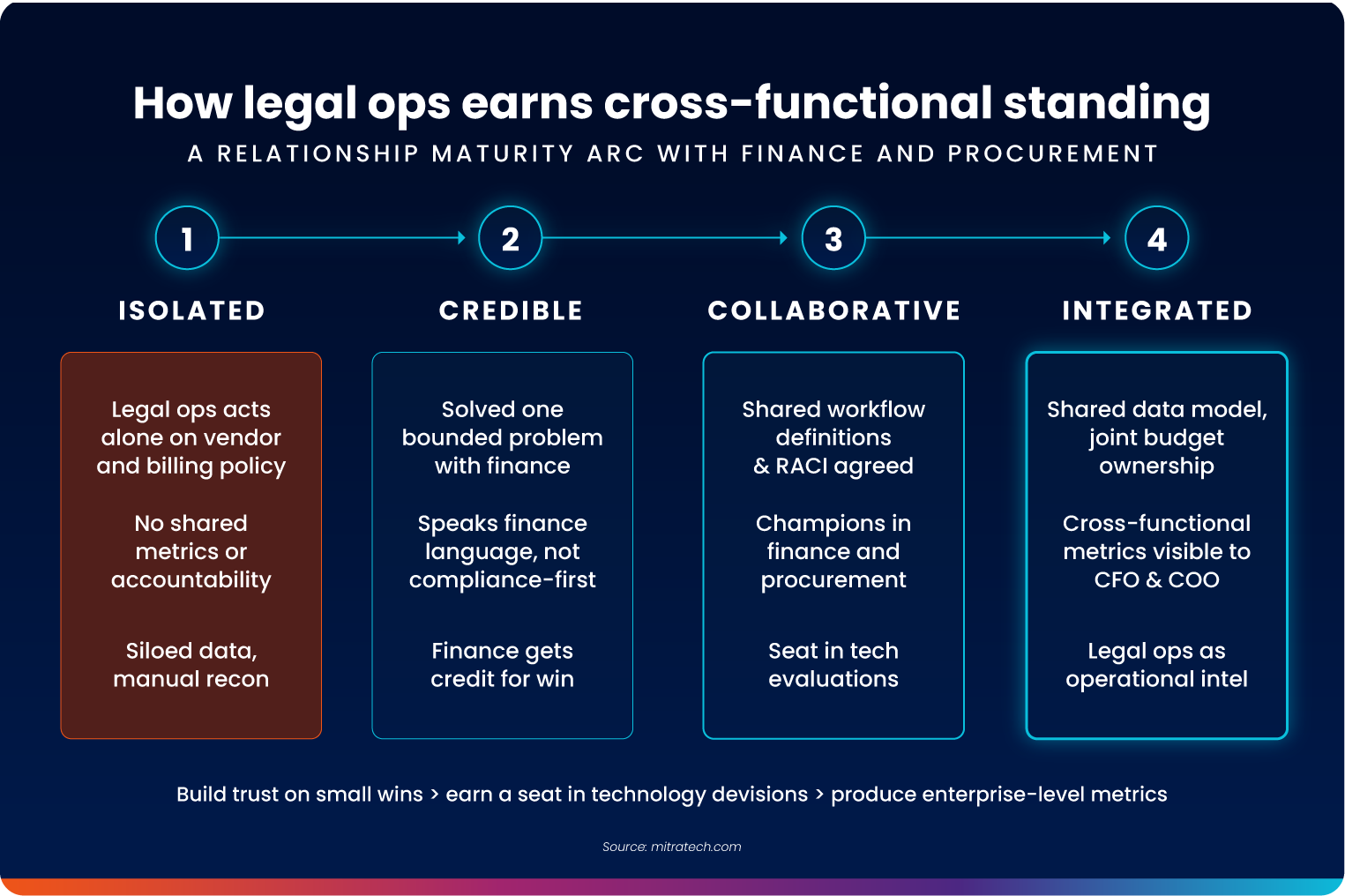
Earn a seat in technology decisions before they’re made. The single highest-leverage intervention a legal ops leader can make is getting into technology procurement conversation, not as a compliance reviewer at the end, but as a stakeholder during the evaluation.
When finance or procurement selects a platform that touches contracts, vendors, or invoices, the data model they choose and the approval workflows they configure will directly shape what legal can and can’t enforce. If legal isn’t there to say ‘this field needs to exist’ or ‘this workflow needs a legal review step,’ those requirements won’t be built in, and retrofitting them later is painful and expensive.
Getting into those conversations requires demonstrating value first. Build a track record with finance and procurement stakeholders on smaller collaborations before asking for a seat at the bigger table. And speak their language: not ‘we need this for compliance,’ but ‘this will reduce your team’s reconciliation time and catch billing errors before they hit the books.’
Negotiate shared definitions before shared systems
Key questions that need cross-functional answers:
- What constitutes a ‘vendor’? Is outside counsel a vendor in the procurement system, or handled separately?
- How do matter budgets in the legal system map to cost center allocations in finance?
- When a contract gets executed, what’s the single source of truth for its terms, and who’s responsible for keeping it current?
These sound administrative. They’re actually governance questions, and the answers need to be negotiated across departments, not decided unilaterally by IT. The teams that get this right establish a small cross-functional working group (typically legal ops, finance ops, and a procurement lead) whose explicit mandate is to define and maintain the shared data model.
Make cost sharing explicit upfront
When a tool serves multiple departments, budget attribution gets awkward fast. Legal ops teams that have successfully deployed shared platforms with finance and procurement have learned that cost sharing needs to be discussed and documented before the contract is signed, not resolved after.
Three models that tend to work:
- Lead department owns the budget, others contribute proportionally. One department sponsors the platform; others contribute based on usage or headcount. Works when one department is clearly the primary user.
- Shared services model. A central ops or IT function owns the platform budget; departments pay a service fee. Works better in larger organizations where centralized shared services infrastructure already exists.
- Joint business case, joint ownership. All departments jointly build the ROI case and share the budget line. Harder to execute but creates the strongest cross-functional alignment; every department has a financial stake in the platform succeeding.
Whichever model you use: document it before implementation and revisit it annually.
Define ownership at every cross-functional handoff
Cross-functional workflows need explicit ownership decisions at every point where work passes from one team to another. When an invoice comes in that doesn’t comply with billing guidelines: who flags it, who investigates it, and who makes the approval decision? When a new vendor needs onboarding: who initiates the process, who conducts legal review, and who has authority to approve?
These are relationship questions as much as process questions. The answers need to be agreed upon by all relevant stakeholders, documented somewhere everyone can find them, and revisited when they stop working.
The most effective teams use a lightweight RACI framework applied specifically to the cross-functional handoff points — not the entire process (which creates documentation overhead nobody maintains), but the specific moments where ownership is ambiguous and errors tend to cluster.
Bringing Finance and Procurement Into Your Legal Tech Roadmap
Legal technology decisions have historically been made inside legal, with minimal input from the teams that legal works most closely with. That’s increasingly untenable as legal tools need to integrate with finance and procurement systems to deliver their core value.
A more collaborative approach in practice:
Share your technology roadmap. Give finance and procurement visibility into what legal ops is planning to deploy and when. This creates opportunities for them to flag integration dependencies early and identify shared opportunities before separate purchasing decisions are made.
Invite them into vendor evaluations. Include a finance and procurement representative in demos and evaluation sessions. They’ll catch requirements you didn’t know to ask for, and their early involvement creates buy-in that makes implementation smoother.
Create a shared system review cadence. Once shared systems are in place, establish a regular cross-functional review — quarterly is typical. Agenda: what’s working, what’s not, what changes are coming that affect other teams, what data quality issues need resolution. This meeting is easy to cancel, right up until something breaks and everyone realizes nobody had been talking.
Be specific about what you need from their systems. ‘We need AP data’ is a much harder request to act on than ‘we need payment confirmation data to flow back into our e-billing system so we can reconcile what was billed, approved, and paid without a manual export step.’
The Hardest Part: Changing How People Work, Not Just How Systems Connect
Even when the technology is right and the process design is sound, cross-functional integration fails when the people involved don’t change how they work. Finance reviewers who’ve always approved invoices without checking billing guidelines won’t start doing it automatically because a new system makes it easier. Procurement leads who’ve never looped in legal on vendor onboarding won’t start doing it because the org chart says they should.
Behavioral change at this scale requires a few things that are distinctly people-and-culture work:
-
Champions in each department
You need at least one person in finance and one in procurement who understands why the integration matters and will advocate for it within their own teams. This person doesn’t have to be the most senior in the department. It’s often more effective when it’s someone in the middle who does the day-to-day work and can translate the abstract value into practical workflow changes.
-
Quick wins that both teams can see
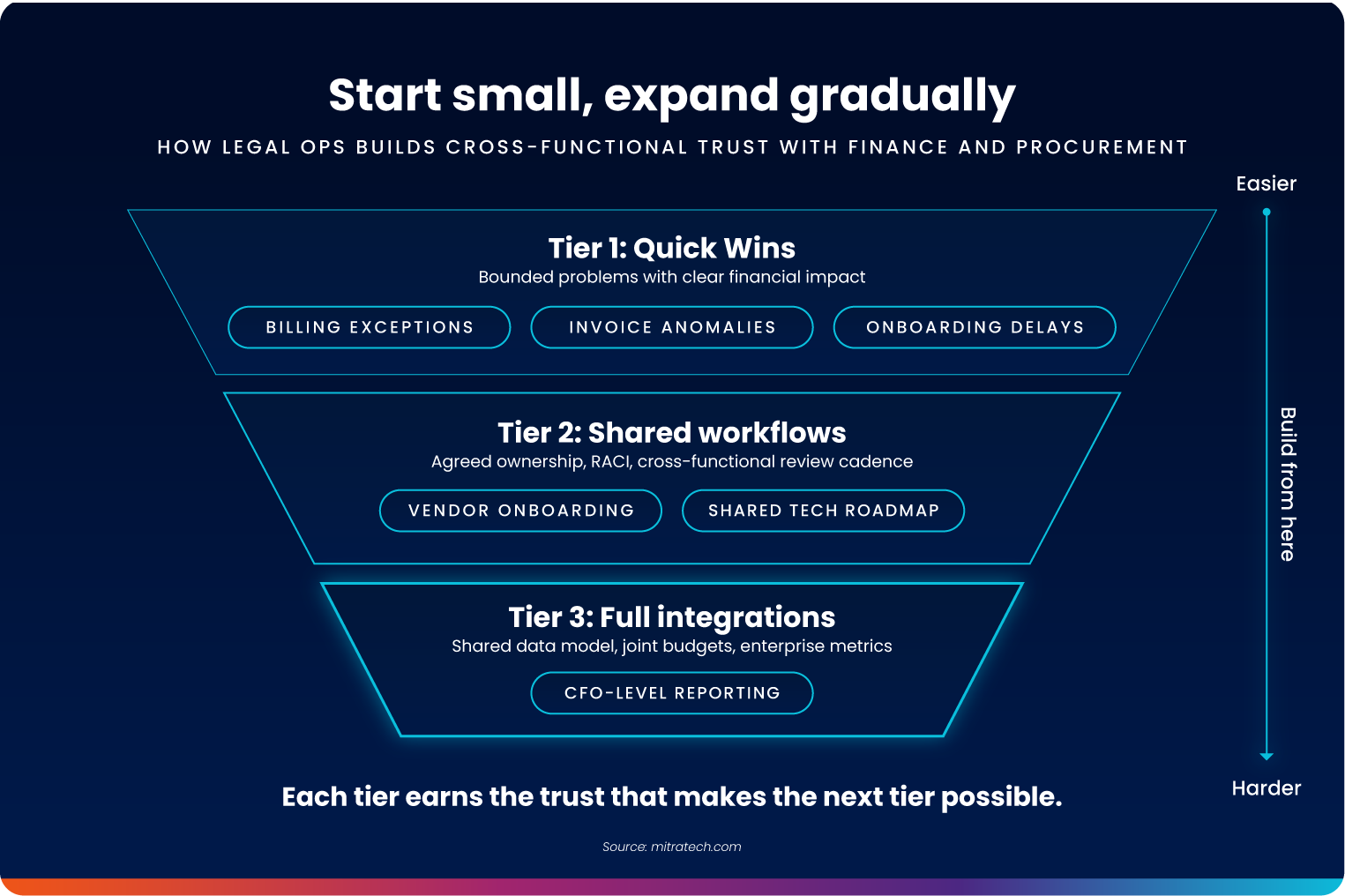
Early in the integration effort, prioritize changes that produce results finance and procurement can actually point to: an invoice exception caught automatically, a vendor risk flag that prevented a problematic onboarding, a budget alert that gave a manager time to intervene before overspend occurred. These stories build the organizational case for deeper integration more effectively than any metrics deck.
-
Honest retrospectives when things don't work
Cross-functional efforts break down when departments retreat to blame rather than joint problem-solving. Establishing the norm early — that you review what went wrong together and fix it together — matters more than any individual process improvement.
-
Measuring Cross-Functional Partnership Value
Once the organizational relationships are in place and shared workflows are operating, the metrics that demonstrate their value to CFOs and COOs — not just General Counsels — become visible for the first time. These aren’t abstract legal metrics; they’re business performance indicators:
- Invoice exception rate by outside counsel firm (only visible when billing guideline data and invoice data are connected)
- Time from contract execution to vendor activation in procurement (measures whether the legal-to-procurement handoff is working)
- Vendor risk incidents by onboarding pathway (shows whether legal review in the onboarding process correlates with downstream risk reduction)
The technical infrastructure that makes these metrics possible — shared data models, bidirectional system integrations, embedded controls — is covered in Part 2. But none of it delivers value without the organizational foundation described here: shared language, clear ownership, and people who have chosen to work across the lines.
When legal ops can speak to operational outcomes that span finance and procurement, the function earns a different kind of credibility: not just a compliance check, but a source of enterprise intelligence. The shift to cross-functional legal operations makes that possible, because shared workflows mean you can finally measure outcomes that neither team could track alone.
The legal ops teams that are winning in 2026 aren’t just the ones with the best technology stack. They’re the ones that have built genuine working relationships with finance and procurement. The technology makes that collaboration more effective. But it’s the collaboration that makes the technology worth buying.
Frequently Asked Questions
How does legal operations add value to finance and procurement beyond compliance?
Legal ops adds value by reducing the manual reconciliation work that finance and procurement currently do to compensate for disconnected systems. When contract data, vendor records, and invoice approvals share a common data model, finance teams spend less time on exception handling and procurement teams have better visibility into vendor risk before commitments are made. The compliance value is real, but the operational efficiency gains are often what actually gets cross-functional investment approved.
What’s the best way for legal ops to build relationships with finance?
Start with a specific, bounded problem that has a clear financial impact. Outside counsel billing exceptions, contract term violations, and vendor onboarding delays are typical starting points. Solve it collaboratively, make sure finance gets credit for the outcome, and use that success as the foundation for a broader working relationship. Trust-building in enterprise functions follows the same logic as any other relationship: start small, deliver consistently, expand gradually.
How do you handle disagreements between legal, finance, and procurement about process ownership?
Process ownership disagreements are almost always data ownership disagreements in disguise. Who controls the vendor record? Who owns the contract terms? Resolving these requires executive sponsorship — someone with authority over all three functions who can make a binding decision — plus a governance structure that defines what happens when ownership needs to change. Without that, the same argument resurfaces every time the workflow is stressed.
What should legal ops prioritize when starting to build cross-functional relationships?
Prioritize the workflows where errors are most costly and most frequent. Invoice approval and vendor onboarding are almost always at the top of that list. Getting those two workflows right — with shared language, clear ownership, and mutual accountability — typically creates enough organizational momentum to justify deeper integration across the full legal-finance-procurement landscape.
The relationships are one thing. The technical implementation is another.
Part 2 covers the integrations, data models, and workflow controls that make legal, finance, and procurement operate from a single source of truth.
Read the Technical Guide