如何评估托管账单审核软件(避免陷入这5个误区)
Discover the truth behind 5 common misconceptions about legal invoice review software and Managed Bill Review (MBR).
Legal teams are under more pressure than ever to control outside counsel spend, prove ROI, and prepare for AI-driven operations. But most evaluations of Managed Bill Review (MBR) software start from the wrong assumptions — and end with the wrong decision.
To that end, this guide breaks down the five most common misconceptions about MBR, and gives you a clearer framework for choosing a solution that actually delivers.
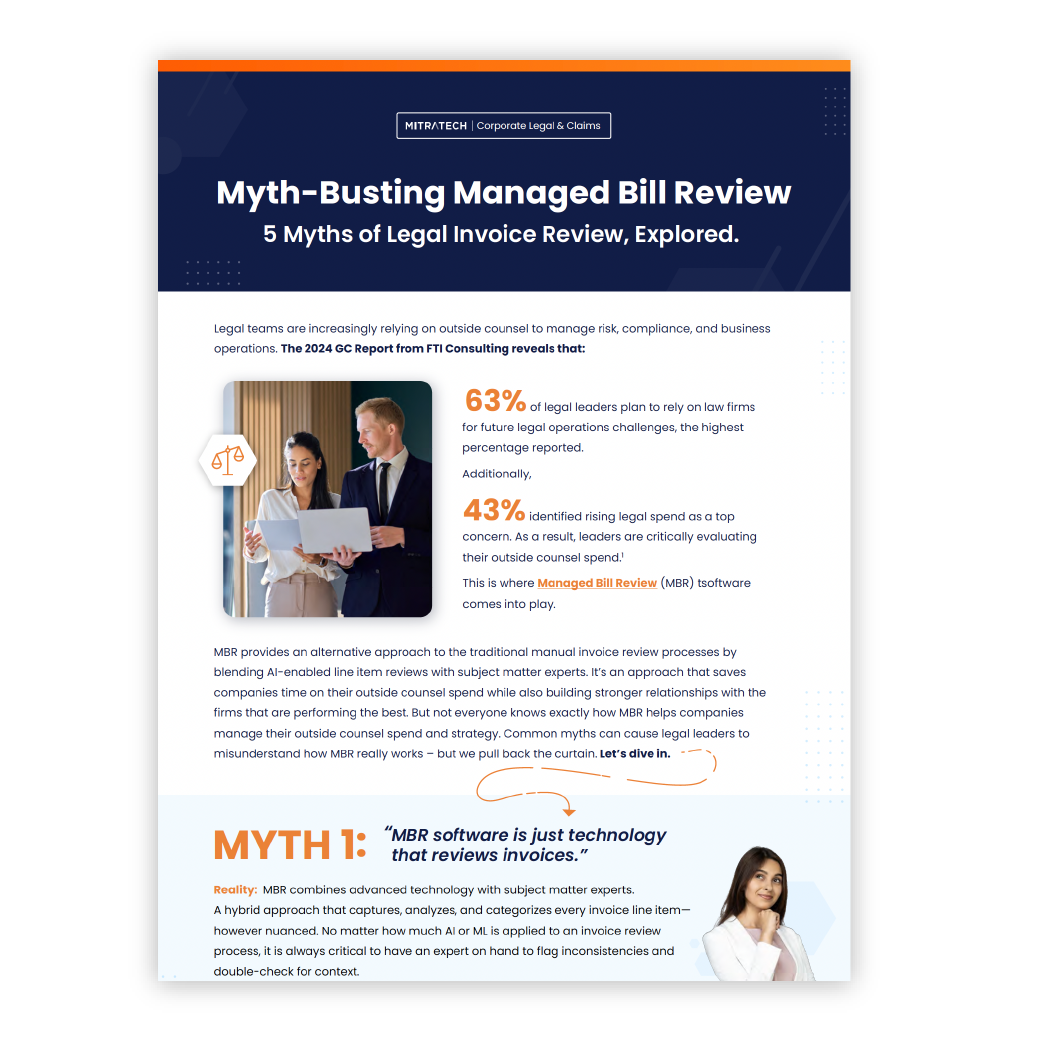
Why MBR Evaluations Go Wrong
Most legal operations leaders approach Managed Bill Review the same way they’d evaluate any software: feature checklist, pricing call, demo. But MBR isn’t like most software. It sits at the intersection of technology, human expertise, and billing compliance. And if you’re evaluating it like a pure SaaS tool, you’re probably asking the wrong questions.
The myths below aren’t obscure. Alternatively, they’re the assumptions we hear most often from legal teams before they’ve implemented MBR, and the ones that most consistently lead to underinvestment, misaligned expectations, or choosing the wrong vendor.
Myth #1: “MBR Software Just Scans Invoices for Errors”
Reality: MBR combines AI + expert analysis for smarter oversight.
It’s the most common misread of what Managed Bill Review actually does. The assumption: you plug in your invoices, an algorithm flags overbilling, you save some money. Done.
The reality is more sophisticated (and more valuable).
In reality, effective MBR combines AI-driven line item categorization with human subject matter experts who can contextualize what the technology finds. An algorithm can flag a billing code anomaly. It takes an experienced legal billing analyst to recognize that the anomaly reflects a pattern across a specific firm’s partners, or that it signals a misunderstanding of your billing guidelines rather than intentional overbilling.
What to look for when evaluating:
- Does the vendor use a hybrid of AI and human review — or purely automated?
- How are their reviewers trained? What’s their background in legal billing compliance?
- What’s their invoice accuracy rate? (Industry-leading solutions operate at 97%+)
The best MBR solutions don’t just catch errors. They build institutional knowledge about your outside counsel relationships over time.

Myth 2: “We Already Have Matter Management — We Don’t Need MBR”
Reality: MBR adds compliance, categorization, and benchmarking to billing.
This is the myth that costs legal departments the most money, quietly. Matter management systems are essential for tracking legal work, including timelines, assignments, and matter status. But they weren’t built to scrutinize billing compliance at the line-item level. Most don’t offer the metadata categorization needed to identify patterns across invoices, and even those that do lack the contextual layer that catches nuanced non-compliance.
Here’s a telling data point: only 36% of legal departments say they know who or what is enforcing their billing guidelines. The rest are assuming their matter management system is handling it. It usually isn’t. MBR doesn’t replace your matter management platform. It integrates with it, adding a compliance, categorization, and benchmarking layer that turns your billing data into something you can actually act on.
So, what do you look for when evaluating?
- Does the MBR solution integrate with your existing matter management and eBilling platforms?
- How does it categorize invoice line items, and can you query that data?
- What reporting does it surface that your current system doesn’t?

Myth 3: “MBR Is a Cost-Cutting Tool, Not a Strategic One”
Reality: It drives strategic law firm relationships and value-based insights.
Savings are real, and they come quickly. But framing MBR purely as a cost-reduction play is what leads legal departments to underestimate its long-term value.
What MBR actually produces, over time, is structured and standardized billing data. And that data becomes the foundation for decisions that go well beyond correcting invoice errors: which firms are delivering the best value per matter type, how to price alternative fee arrangements, where to deepen strategic outside counsel relationships, and where to pull back. Legal departments that use MBR well don’t just spend less. They spend smarter. and they have the data to show why.
What to look for when evaluating:
- What benchmarking data does the vendor provide, and how granular is it?
- Can you analyze firm performance across regions, matter types, and timekeeper rates?
- Does the platform support data-driven outside counsel reviews and negotiations?

Myth 4: “MBR Has Nothing to Do With AI Readiness”
Reality: MBR enables AI-readiness through structured invoice data.
If your organization is investing in AI for legal operations, this myth is the one that will set you back the furthest.
AI tools are only as good as the data they’re trained on and fed. Legal AI applications — predictive spend analytics, matter outcome modeling, automated reporting — require billing data that is clean, consistently categorized, and well-structured. Most legal departments don’t have that. Their invoice data is siloed, inconsistently tagged, and full of errors that never got corrected.
MBR fixes that problem upstream. The categorization and validation processes that MBR applies to every invoice produce exactly the kind of structured, tagged billing data that AI tools need to generate meaningful insights.
Put simply: if you want AI to work in your legal department, start with MBR.
What to look for when evaluating:
- What data structure does the vendor’s categorization system produce?
- Is the output compatible with your BI and analytics tools?
- Does the vendor have a roadmap for AI-driven analytics built on MBR data?

Myth 5: “ROI Takes Years to Materialize”
Reality: ROI is typically realized early — and compounds over time.
This one keeps more legal departments on the sidelines than any other myth, and it’s the least accurate.
Most organizations see measurable ROI within the first few months of implementing MBR, driven by early wins: corrected billing discrepancies, recovered overcharges, and faster invoice approval cycles. The savings from those early corrections alone often justify the investment before the end of the first year.
What compounds over time isn’t the ROI; it’s the efficiency. As MBR becomes embedded in your workflows and your billing data accumulates, the process becomes more automated, the insights sharper, and the cost of running it lower. Year two looks better than year one. Year three better than year two.
What to look for when evaluating:
- What does the vendor’s typical time-to-value look like? Ask for specific customer examples.
- How does ROI compound as the platform matures?
- What’s included in their implementation and onboarding support?
As a starting point, you can use a free MBR ROI calculator to estimate how much your legal team could save with a Managed Bill Review solution.

What a Strong MBR Evaluation Actually Looks Like
If you take nothing else from this guide, use these as your evaluation criteria:
1. Hybrid model — AI categorization plus human expert review, not one or the other.
2. Integration — Works alongside your matter management and eBilling platforms, not instead of them.
3. Strategic data — Produces benchmarking and firm performance data, not just compliance flags.
4. AI-ready output — Generates structured, tagged billing data compatible with analytics tools.
5. Demonstrated ROI — Vendor can show real customer results within months, not years.
Want the PDF version?
Download the complete guide as a PDF (no form required). Or learn more about how MBR would work for your legal ops team.
常见问题
What are the benefits of using a managed bill review service?
Managed Bill Review delivers value across three areas. First, immediate cost savings: identifying and correcting billing discrepancies, overcharges, and guideline violations that most legal teams miss. Second, operational efficiency: removing the manual, time-intensive burden of line-item invoice review from your team so they can focus on higher-value work. Third, strategic insight: producing structured billing data and firm performance benchmarks that inform outside counsel decisions, AFA negotiations, and long-term spend strategy. Organizations using MBR typically see 15% or more in annual cost reduction, with 2–3x ROI over the life of the program.
What should I look for when evaluating managed bill review vendors?
The five criteria that matter most are: (1) a hybrid model combining AI categorization with human expert review; (2) integration capability with your existing matter management and eBilling systems; (3) benchmarking and firm performance reporting, not just compliance flagging; (4) structured data output compatible with analytics and AI tools; and (5) demonstrated customer ROI within months, not years. Ask vendors for specific customer examples and time-to-value data — not just case study highlights.
What's the difference between software and managed bill review services?
Standard legal billing software automates rule-based compliance checks against your billing guidelines. Managed Bill Review goes further: it combines that automation with AI-driven line item categorization and human expert analysis to catch what software alone misses. The “managed” component means a team of legal billing specialists is actively reviewing invoices alongside the technology — providing the contextual judgment that algorithms can’t replicate. The result is higher accuracy (97%+), richer data, and strategic insights rather than just compliance flags.
Should I outsource legal invoice review or keep it in-house?
For most corporate legal departments, outsourcing to a managed bill review solution delivers better results than in-house review — not because in-house teams lack capability, but because MBR provides scale, consistency, and expertise that’s difficult to replicate internally. In-house review is prone to inconsistency, resource constraints, and blind spots around billing patterns. MBR applies standardized categorization and expert analysis across every invoice, every time. The data it produces is also far more actionable than what manual review typically generates.
What expertise should I expect from a managed bill review provider?
Look for providers whose review teams include professionals with backgrounds in legal billing compliance, outside counsel management, and legal operations — not just general finance or accounts payable. The best providers train their reviewers specifically on legal billing guidelines, task codes, and the nuances of outside counsel invoicing. They should be able to identify invoice bundles, unauthorized expenses, timekeeper rate discrepancies, and billing guideline violations that require contextual judgment, not just rule-matching.
How do managed services ensure billing guideline compliance?
Effective MBR enforces billing guideline compliance through three layers: rule-based automation that flags obvious violations, machine learning categorization that identifies patterns and anomalies across large invoice sets, and human expert review that catches context-dependent issues the technology surfaces but can’t fully resolve. This layered approach ensures that compliance isn’t assumed — it’s verified, documented, and reported on consistently across all outside counsel relationships.
What's the ROI of using managed legal bill review?
ROI from MBR typically materializes in two phases. In the first few months, organizations recover costs through corrected billing discrepancies and faster invoice cycles — most see measurable savings before the end of the first year. Over time, ROI compounds as the process becomes more automated, billing data accumulates, and the strategic insights from firm performance benchmarking inform better outside counsel decisions. Organizations using Mitratech MBR report 2–3x ROI over the life of the program, with 15%+ annual reductions in legal spend.
How much can I save by using professional legal bill reviewers?
Savings vary by organization size, invoice volume, and current compliance maturity — but professional MBR consistently delivers 5–15% in annual legal spend reduction through direct cost recovery alone. When you factor in efficiency gains (reduced admin hours, faster invoice cycles) and the downstream value of better outside counsel decisions informed by MBR data, total program value typically reaches 2–3x the cost of the solution. The most accurate way to estimate your specific savings is to benchmark your current invoice error rate and billing guideline compliance against industry norms.
Get the Full Guide
We've packaged everything above — plus additional evaluation criteria, questions to ask vendors, and a breakdown of what 2–3x ROI actually looks like in practice — into a single PDF you can share with your team or use in an internal business case.

©2026 Mitratech, Inc. 保留所有权利。

©2026 Mitratech, Inc. 保留所有权利。