HR Compliance
HR Compliance Software
A practical look at what HR compliance requires today, how to assess where your organization stands, and how Mineral Elite helps employers keep pace with federal, state, and local law changes.
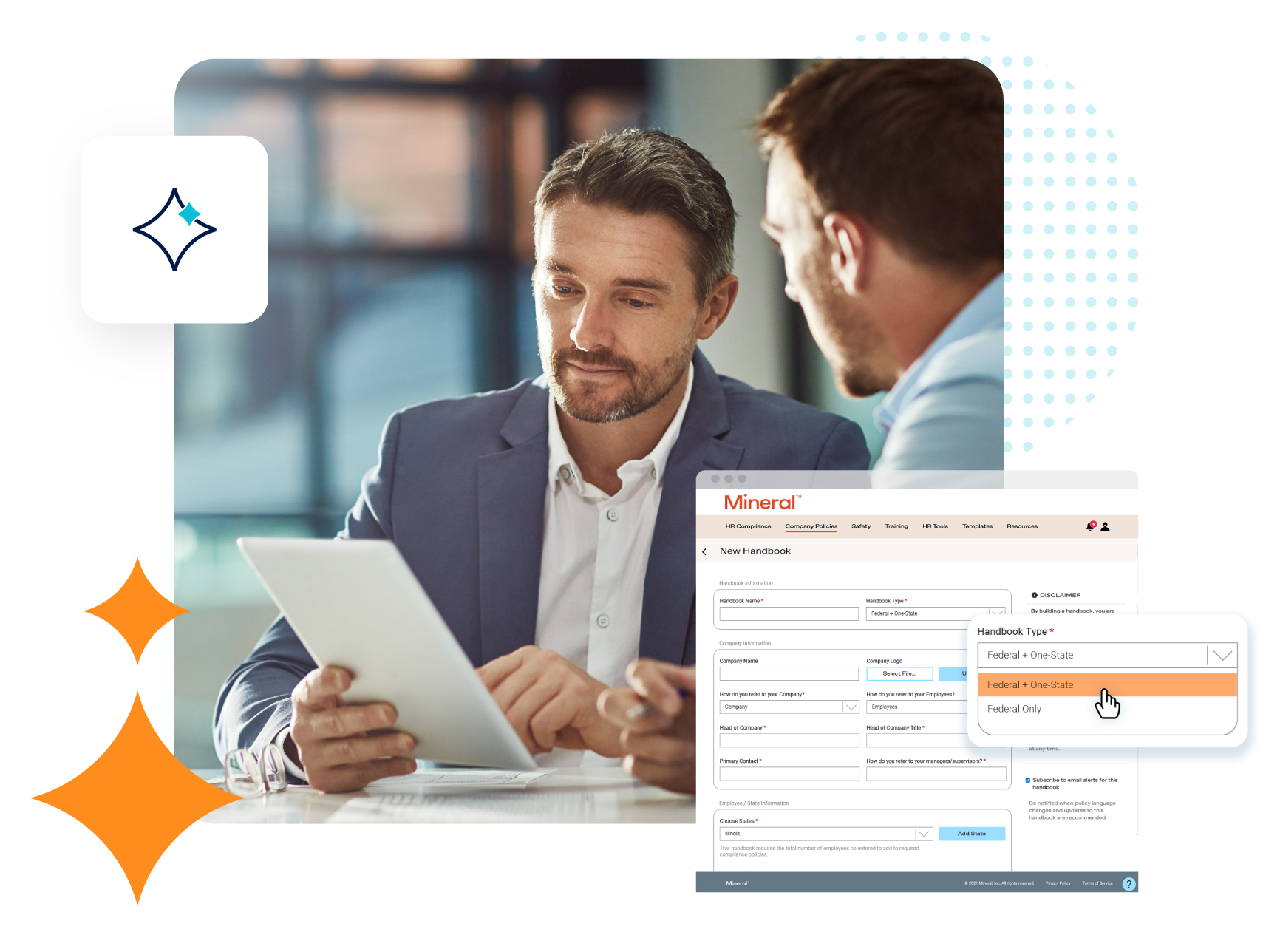
什么是人力资源合规?
HR compliance is the practice of aligning your organization’s employment policies, processes, and decisions with the federal, state, and local laws that govern the workplace.
It runs across the entire employee lifecycle — from hiring through classification, pay, leave, accommodation, discipline, and off-boarding — and it requires both knowing the current rules and consistently applying them.
It’s helpful to separate HR compliance from employment law itself. Employment law is the rulebook; HR compliance is how you follow it inside your organization, translating statutes into the policies, processes, and actions your business actually takes.

Compliance in HR is continuous and broad. Here are the main areas it spans:
|
What it Governs |
|
|---|---|
|
Hiring & Recruiting |
Job postings, background checks, interview practices, equal opportunity |
|
Wage & Hour |
Minimum wage, overtime, breaks, pay timing, pay transparency |
|
Worker Classification |
Employee vs. contractor, exempt vs. non-exempt |
|
Anti-Discrimination & Harassment |
Title VII, ADA, ADEA, state protections, required training |
|
Leave & Accommodation |
FMLA, state leave laws, ADA accommodations, sick time |
|
工作场所安全 |
OSHA standards, reporting, logs |
|
益处 |
ERISA, COBRA, healthcare reporting |
|
Recordkeeping |
Required documentation, retention periods, data privacy |
|
Termination & Offboarding |
Final pay, notice rules, separation documentation |
Who owns it depends on size.
In large organizations, HR compliance may sit with a dedicated compliance officer or legal team. In most small and mid-sized businesses, it falls to whoever runs HR, sometimes a founder or an office manager wearing several hats. In practice, the responsibility is shared: leadership sets the tone and budget, HR maintains policies and training, and managers make compliant decisions day to day. The usual failure point isn’t bad intent. It’s that no single person has the time or current legal knowledge to own it fully.
The problem
Why HR Compliance Keeps Getting Harder
The demands on HR and compliance teams are intensifying, and the people closest to the work say so directly. In the State of HR Compliance Report, we surveyed HR and compliance professionals who described a landscape that is both broadening and accelerating:
- 75% said their compliance needs have changed.
- 54% said those needs have increased over the past two years.
- 51% named AI compliance as the top emerging compliance trend.
- 41% cited talent attraction and retention as their top challenge.
Together, these findings point to a structural reality: the body of law governing the workplace expands and shifts continually, while the teams responsible for keeping pace rarely grow at the same rate.

The Forces Driving the Complexity
Several pressures compound that gap:
-

Employment law changes faster than teams can track.
With thousands of federal, state, and local updates each year across wages, leave, scheduling, pay transparency, and classification.
-
Multi-state and remote work
Every new state you operate in adds another layer of law. Multi-state and remote work multiplies the rules.
-
Fines and Lawsuits
The risk is real, ranging from fines and back pay to lawsuits and audits, and it often goes unnoticed until a complaint surfaces it.
-
Gaps You Don't Know You Have
Many organizations simply don’t know what applies to them given their size, locations, and headcount.
-
Enterprise Obligations
Smaller employers carry nearly the same obligations as large enterprises, with no dedicated compliance function to manage them.
-
Handbooks and policies
Outdated handbooks and policies quietly become sources of exposure.


What HR Compliance Should Do for Your Business
However you manage it, a dependable approach does the same core jobs:
Track law changes across federal, state, and local jurisdictions, and turn each one into a clear next step rather than a headline to interpret.
Stay Ahead of Every Update
Keep policies and handbooks current as those laws change, in every state you operate in.
Policies That Keep Pace
Assign, track, and document training, including requirements like anti-harassment training that are mandatory in certain states and roles.

Training, Tracked and Defensible
Surface gaps through audits while they’re still cheap to fix.

Find Gaps Before They Find You
Provide access to real experts for the questions a checklist or library can’t answer.

Experts When You Need Them
Keep records audit-ready, with retention rules applied, so you can produce what an auditor or attorney asks for.
Always Audit-Ready
Underneath all of it sits a single gap: the distance between compliance on paper and what is actually happening day to day. Closing that gap is what HR compliance is really about.
Is Your Approach Keeping Up?
Every employer has HR compliance obligations from its first hire. The real question is whether your current approach is keeping up. Ask yourself, and check any that apply:
Your employee handbook hasn’t been reviewed against current law in the last 12 months.
You’ve hired in a new state and aren’t sure what changed.
You’re unsure whether your workers are classified correctly.
Nobody on your team is alerted when a relevant law changes.
You handle compliance questions by searching online and hoping the answer is current.
You can’t quickly produce the records an auditor or attorney would ask for.
Close The Compliance Gap
If even one of these sounds familiar, you have a gap worth closing, and the more you check, the more exposure is quietly building in the background.
This is most acute for small and mid-sized businesses, which carry nearly the same obligations as large enterprises but rarely have a dedicated compliance team. Below roughly 100 employees, most companies can’t justify a full-time compliance hire, which is exactly why software and on-demand expert access exist: to give a one-person HR function the coverage of a much larger team. The risk concentrates wherever you cross state lines, since wage, leave, and notice rules vary by jurisdiction and change often.
What To Look For
If you're evaluating a more deliberate approach, these criteria separate a dependable solution from a basic content library:
-
Coverage across federal, state, and local law, not federal alone, since that’s where most risk lives.
-
Proactive alerts that tell you what changed and what to do, rather than leaving you to research.
-
Access to real HR experts, not just a searchable library, for complex or sensitive questions.
-
Scalability as you add employees, states, and locations.
-
Audit-readiness built in, with documentation and retention handled.

Why Mineral Elite
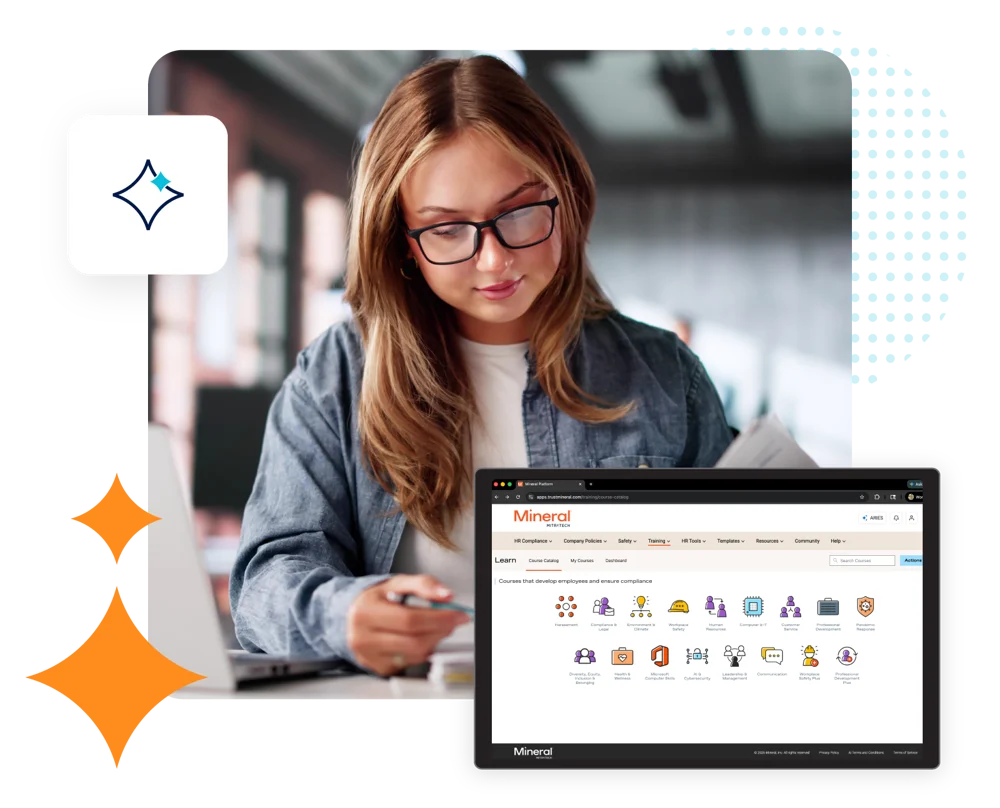
Mineral Elite is Mitratech’s HR compliance platform, built to do the jobs above in one place. Mitratech Mineral Intelligence tracks 3,000+ federal, state, and local employment laws and tells you what changed, where, and what to do about it. Certified HR Experts are on hand for questions that need a human touch. And policies, handbooks, and training live on the same platform, so staying current doesn’t mean stitching tools together. Trusted by 1.7M+ employers, Mineral Elite gives a small HR team the coverage of a much larger one.
Frequently Asked Questions by HR Teams
What are the main areas of HR compliance?
HR compliance spans nine core areas: hiring and recruiting, wage and hour, worker classification, anti-discrimination and harassment, leave and accommodation, workplace safety, benefits, recordkeeping, and termination. Each is governed by its own mix of federal and state laws, from Title VII and the ADA to FMLA, OSHA, and ERISA. Most gaps appear where these areas intersect with state-specific rules.
Is HR compliance the same as employment law?
No. Employment law is the body of statutes and regulations; HR compliance is the practice of following those laws inside your organization. Put simply, employment law is the rulebook, and HR compliance is how you play by it.
Who is responsible for HR compliance?
In large organizations, it often sits with a dedicated compliance officer or legal team. In most small and mid-sized businesses, it falls to whoever runs HR, sometimes a founder or office manager. In practice, it is shared across leadership, HR, and managers, which is why gaps usually trace to no one having time to own it fully rather than to bad intent.
How do I know if my organization is HR compliant?
The most reliable way is a periodic self-audit against current federal, state, and local requirements. Warning signs of a gap include a handbook that hasn’t been reviewed in over a year, recent hiring in a new state, uncertainty about worker classification, no alerts when laws change, and difficulty producing records on request.
What are the consequences of HR non-compliance?
Non-compliance can lead to fines, back pay, lawsuits, audits, and reputational damage, and penalties are often assessed per violation, so they compound quickly across a workforce. These costs frequently go unnoticed until a complaint or claim surfaces them, which is when they are most expensive to resolve.
Do small businesses have to follow HR compliance laws?
Yes. Small and mid-sized businesses carry nearly the same obligations as large enterprises, including wage and hour rules, anti-discrimination protections, required postings, leave laws, and safety standards. What changes with size is capacity, which is why many smaller employers rely on software and on-demand expert access instead of a full-time compliance hire.
How much does HR compliance cost without software?
It varies, but the hidden costs add up: staff hours spent researching law changes, outside counsel for one-off questions, handbook updates, and the exposure created by anything that slips through. For most small and mid-sized employers, those combined costs are why dedicated software and on-demand expert access exist.

©2026 Mitratech, Inc. 保留所有权利。
©2026 Mitratech, Inc. 保留所有权利。