Two things can be true at once:
1) Artificial intelligence is rapidly becoming part of modern legal operations, and 2) most AI innovations still aren’t designed for the realities of legal work.
Legal teams operate in environments where defensibility, auditability, compliance, and human oversight matter as much as speed and automation. And recent headlines about AI plugins causing unintended data loss make the stakes impossible to ignore: when AI acts without guardrails, legal teams are left defending decisions they never made and losses they never authorized.
With that in mind, Governance-grade AI is an approach to AI designed to support those operational and regulatory expectations without compromising control or trust.
In practice, Governance-grade AI helps legal teams:
- Apply AI within controlled, auditable workflows
- Improve operational efficiency without sacrificing oversight
- Maintain visibility into legal data and decisions
- Support defensibility, compliance, and regulatory readiness
- Keep humans involved in legal judgment and approvals
- Reduce manual administrative work through governed automation
En este artículo:
- What Is Governance-Grade AI?
- Why Legal Teams Need Governance-Grade AI
- Governance-Grade AI vs General-Purpose AI
- Core Characteristics of Governance-Grade AI
- How Governance-Grade AI Is Being Applied in Legal Operations
- What Legal Leaders Should Evaluate Before Adopting AI
- Governance-Grade AI and the Future of Legal Operations
- Preguntas frecuentes
What Is Governance-Grade AI?
Governance-grade AI refers to AI systems designed to operate within structured governance, compliance, security, and operational frameworks. Unlike consumer AI tools built primarily for open-ended generation, governance-grade AI is designed to support enterprise environments where:
- Data security matters
- Permissions and access controls matter
- Auditability matters
- Workflows matter
- Accountability matters
- Regulatory obligations matter
For legal teams specifically, governance-grade AI focuses on helping organizations modernize legal operations while maintaining visibility, defensibility, and operational control. Here at Mitratech, we describe this approach as: “practical, governance-grade AI and automation” designed to help legal teams manage legal operations with greater visibility, defensibility, and control.
Why Legal Teams Need Governance-Grade AI
Legal departments face a different set of operational realities than many other business functions. These teams manage:
- Privileged information
- Regulatory obligations
- Litigation workflows
- Outside counsel relationships
- Compliance processes
- Sensitive operational data
As AI adoption accelerates, legal leaders are asking practical questions:
- How is data handled?
- Can outputs be audited?
- Who has access?
- How are permissions enforced?
- How is AI integrated into existing workflows?
- What role does human review play?
- Who is responsible or liable for AI-executed tasks or decisions?
Governance-grade AI attempts to answer those questions directly through controlled, operationally grounded AI systems.
Governance-Grade AI vs General-Purpose AI
| General-Purpose AI | Governance-Grade AI |
|---|---|
| Open-ended generation | Workflow-oriented execution that understands the operational context and unique rules and history of your legal team |
| Limited operational controls | Structured governance and permissions |
| Minimal or no policy enforcement | Legal-specific governance and ethical walls |
| Consumer-oriented experiences and support | Dedicated account manager and strategic partnership for long-term success and governance planning |
| No approval workflows | Native legal review and signoff workflows |
| Basic auditability, not built as records-management systems | Traceable workflows, oversight, and repository |
| Broad data exposure risks | Customer-isolated architecture, inherited enterprise access, and data handling |
| Generic outputs | Context-aware operational support |
| No matter or system of record linkage | Every action tied to matter, case, contract, or entity |
| Baseline security compliance | Built for SEC, FINRA requirements, GDPR retention controls and other GRC regulations |
Governance-grade AI does not remove human judgment from legal work. Instead, it is designed to augment legal professionals by helping automate repetitive operational tasks, surface insights, and support faster decision-making within governed environments.
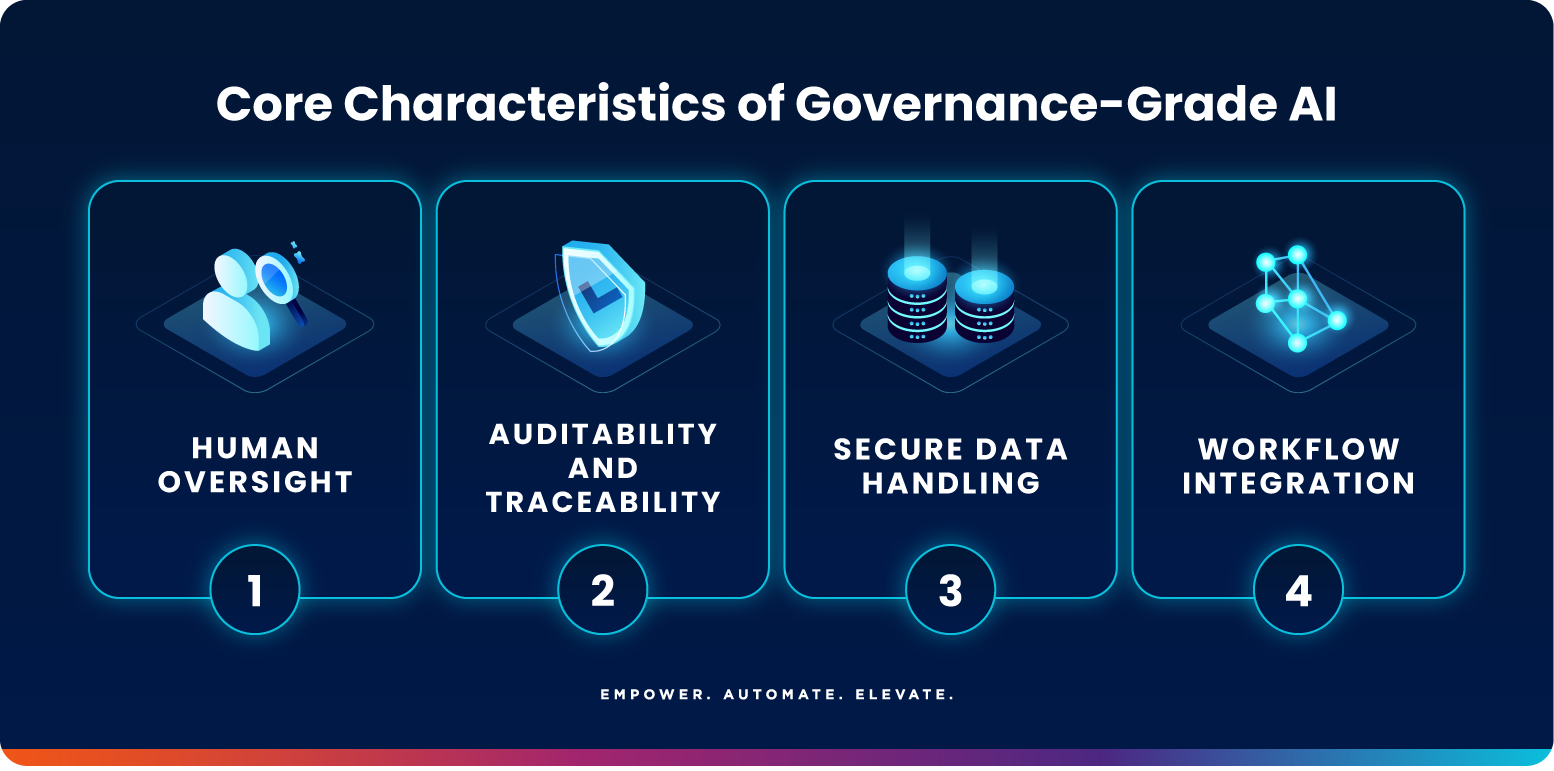
Core Characteristics of Governance-Grade AI
-
Human Oversight
Governance-grade AI is designed to support legal professionals, not replace legal judgment. AI should always be framed as augmenting legal judgment in instances like:
- Human approval workflows
- Reviewable AI-generated outputs
- Escalation paths
- Attorney oversight
- Auditable recommendations
-
Auditability and Traceability
Legal operations require defensible processes. Governance-grade AI systems often include:
- Audit trails
- Reporting visibility
- Workflow history
- Explanation layers
- Permissions tracking
- Matter-level context
For example, Mitratech ARIES™ capabilities are designed to provide:
- Traceable, accurate insights
- Contextual reporting
- Governed data access
- Explainable outputs tied to system-of-record data
-
Secure Data Handling
AI governance increasingly depends on how systems handle enterprise data.
Mitratech’s ARIES™ framework outlines:
- Role-based access control
- Encryption in transit and at rest
- Customer data segregation
- Audit controls
- Access permissions
- Secure cloud infrastructure
For legal organizations, these operational controls are often as important as the AI functionality itself.
-
Workflow Integration
Governance-grade AI is most effective when embedded inside existing legal workflows rather than operating as disconnected tools.
Algunos ejemplos son:
- Gestión de asuntos
- Revisión de facturas
- Legal intake
- Automatización del flujo de trabajo
- Document automation
- Legal hold processes
- Spend analytics
This operational integration helps legal teams reduce friction while maintaining centralized visibility into legal operations.
How Governance-Grade AI Is Being Applied in Legal Operations
Legal Spend and Invoice Analysis
AI-enabled spend management systems can help:
- Categorize invoice line items
- Identify anomalies
- Flag billing guideline violations
- Surface spend trends
- Improve reporting visibility
Mitratech materials describe AI-assisted invoice review as combining:
- AI-driven analysis
- Expert human review
- Structured billing oversight
- Spend analytics
Gestión de asuntos
Governance-grade AI can support:
- Matter intake
- Matter summaries
- Budget visibility
- Informes
- Workflow recommendations
- Operational analytics
Mitratech ARIES™ capabilities include natural-language querying and contextual analysis directly within legal management environments.
Automatización del flujo de trabajo
Legal workflow automation platforms increasingly incorporate AI to:
- Route requests
- Surface policies
- Automate intake
- Streamline approvals
- Reduce repetitive administrative work
Mitratech describes these capabilities as: “governance-grade AI powers smarter workflows, faster decisions, and more consistent outcomes across every stage of legal work.”
Document and Contract Automation
Governance-grade AI can help legal teams:
- Standardize document generation
- Reduce drafting inconsistencies
- Automate repetitive workflows
- Enforce approved language and logic
- Improve operational consistency
Importantly, these systems are typically grounded in approved templates, governed workflows, and centralized controls rather than unrestricted generation.
What Legal Leaders Should Evaluate Before Adopting AI
Does the AI operate within governed workflows?
AI tools should align with operational processes, permissions, and review structures.
Is there human review?
Legal judgment and approvals should remain part of the process.
How is data secured?
Organizations should understand:
- Access controls
- Cifrado
- Storage architecture
- Audit logging
- Data segregation
Can outputs be traced and audited?
Legal operations often require explainability and defensibility.
Does the AI integrate with existing systems?
Disconnected AI tools can create operational fragmentation and governance risk.
Governance-Grade AI and the Future of Legal Operations
AI adoption inside legal departments is increasingly shifting from experimentation toward operational execution. Legal leaders are looking beyond generic AI assistants, isolated point tools, and disconnected automation. Instead, many organizations are evaluating how AI fits into enterprise governance, operational reliability, legal workflows, compliance programs, and centralized legal platforms.
Mitratech’s Legal Solutions positioning reflects this broader shift toward unified legal operations — embedded AI, workflow automation, enterprise-grade governance, and operational visibility working together rather than in parallel.
A consumer LLM is primarily a reasoning/generation layer. An enterprise legal system of record is the authoritative governance layer. The strongest enterprise architectures increasingly combine both:
- AI for analysis, drafting, summarization, and recommendations
- System of record for governance, memory, workflows, retention, and auditability
Governance-grade AI is the architecture that makes that combination work, so legal teams can move faster without losing the visibility and control that defensible legal work requires.
Preguntas frecuentes
What is governance-grade AI?
Governance-grade AI refers to AI systems designed to operate within structured governance, compliance, security, and operational frameworks, particularly in enterprise environments like legal operations.
Why is governance-grade AI important for legal teams?
Legal teams manage sensitive data, compliance obligations, and defensible workflows. Governance-grade AI helps support operational efficiency while maintaining oversight, auditability, and control.
How is governance-grade AI different from general AI tools?
Unlike general AI tools, Governance-grade AI focuses on operational controls, permissions, auditability, workflow integration, and enterprise governance rather than unrestricted content generation.
Does governance-grade AI replace legal professionals?
No. Governance-grade AI is designed to augment legal work by supporting operational efficiency, surfacing insights, and automating repetitive workflows while keeping humans involved in legal judgment and approvals.
What should legal teams look for in AI platforms?
Legal teams should evaluate:
- Security controls
- Auditability
- Workflow integration
- Permissions management
- Human oversight
- Operational visibility
- Asistencia en materia de cumplimiento normativo