
If your legal department outsources any work to outside counsel, legal spend management is one of the highest-impact disciplines available to you.
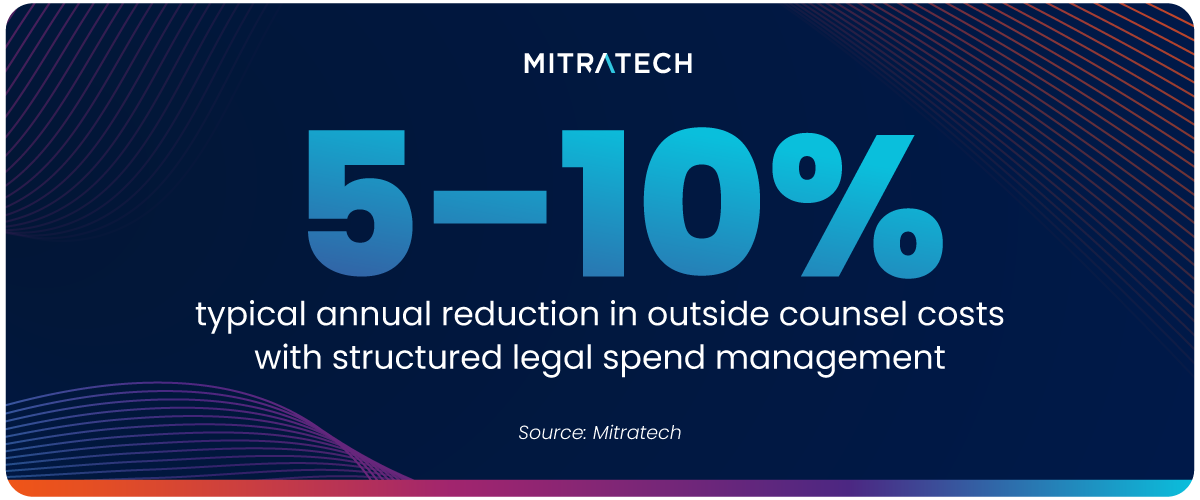
Organizations with a strong legal spend management system in place typically reduce outside counsel costs by 5–10% annually, and those without one often overpay firms by the same amount every year through undetected billing errors, unenforced guidelines, and rate increases that slip through without review.
This guide covers the basics of legal spend management: what it is, why it matters, and what outcomes organizations report after implementing it. If you’re already past the basics and ready to see a solution overview or request a demo, the legal spend management software page has everything you need.
¿Qué es la gestión de gastos jurídicos?
Legal spend management is how corporate legal departments take control of outside counsel costs, tracking budgets by matter and practice area, enforcing billing guidelines, analyzing firm performance, and generating the financial reporting that General Counsel and CFOs need to demonstrate ROI. For most in-house teams, outside counsel fees are the largest and least predictable line item in the legal budget. Legal spend management software exists to change that.
Another way to think about it: legal spend management is the management of “spend data” through software tools built around core data classification and enrichment technologies. There are many ways to analyze legal spend data, and it is further enriched by spend analytics tools focused on alerting, measuring, and reporting on costs across matters, firms, timekeepers, and practice areas.
As Lora Cecere of AMR Research puts it, effective spend management gives organizations the ability to analyze the impact of sourcing strategies on key categories, along with assessments of business results, measurement of KPIs, and ongoing control of spend for improved profitability. While her comment addresses procurement, the principle applies directly to legal. Many legal operations professionals have moved well beyond enforcing billing guidelines, and now use legal spend analytics to inform sourcing decisions, firm negotiations and selection, and targeted programs to drive down outside counsel spend overall.
Legal spend management is also a core component of any enterprise legal management (ELM) platform, typically designed with functionality across multiple areas of corporate legal management and operations including e-billing, matter management, analytics, and reporting.
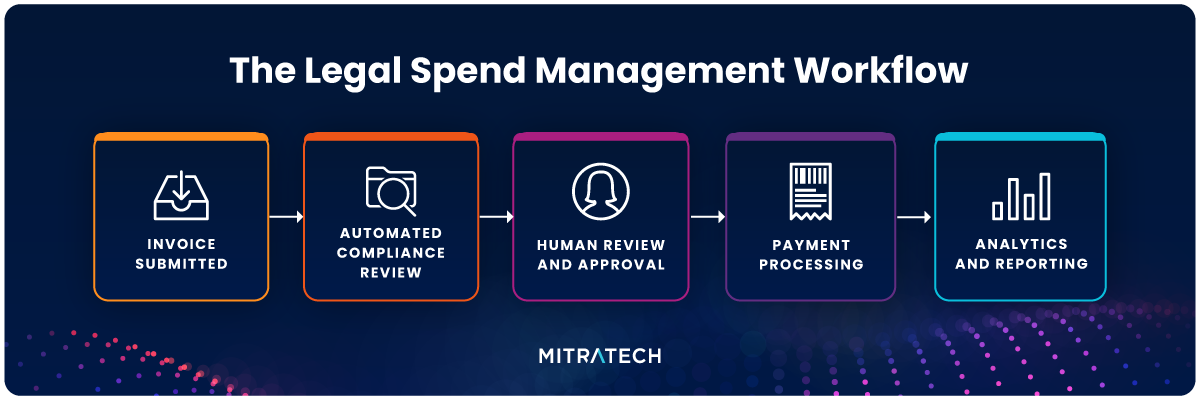
What Does Legal Spend Management Cover?
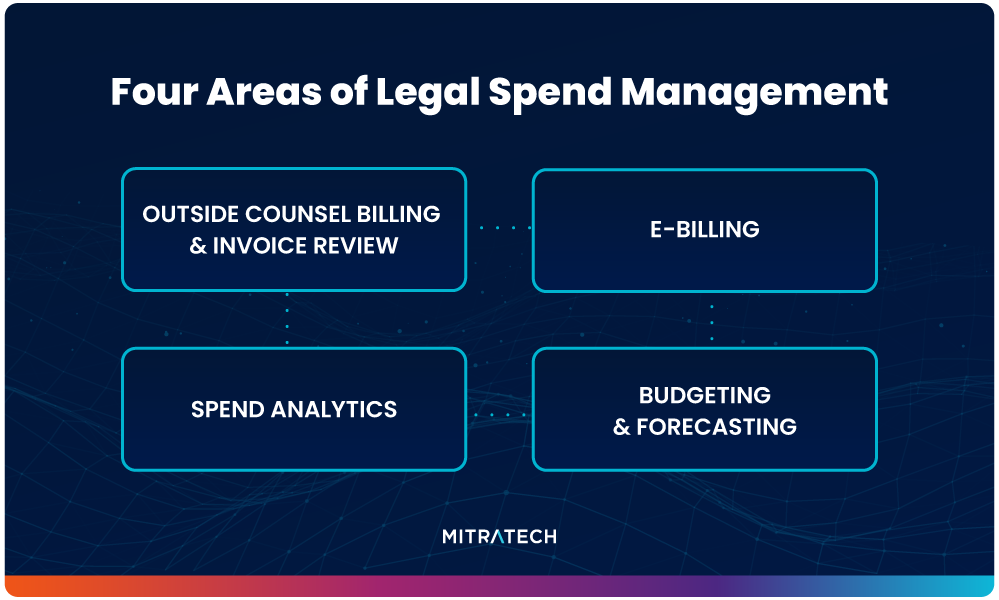
Legal spend management encompasses four interconnected areas.
Outside counsel billing and invoice review: The most immediate layer is controlling what outside counsel bills and ensuring every invoice complies with your billing guidelines before payment is approved. Without a reliable system for enforcing billing standards, staff attorneys spend excess time finalizing and approving invoices — and companies often end up overpaying firms by 5–10% annually due to undetected errors. See how automated invoice review works →
E-billing: Electronic billing is the technology infrastructure that makes legal spend management scalable. An e-billing portal allows law firms to submit invoices in a standardized format directly into the legal department’s platform, where they are automatically checked against billing guidelines before review and approval. Moving from manual invoice processing to e-billing alone typically delivers 5–10% in annual savings. Learn more about Mitratech’s e-billing capabilities →
Spend analytics: Beyond individual invoice review, legal spend management involves analyzing spend patterns across matters, firms, timekeepers, practice areas, and time periods. This is where the strategic value lies — understanding not just what you paid, but whether it was well spent, how it compares to benchmarks, and where costs are likely to go next. Explore legal spend analytics →
Budgeting and forecasting. Effective legal spend management connects historical spend data to forward-looking budget planning. Legal departments can set matter budgets, track actual spend against those budgets in real time, and build data-driven forecasts that improve predictability for finance and the C-suite.
Why Corporate Legal Departments Need Legal Spend Management
Medium to large corporate legal departments may process thousands of invoices from law firms every year. When companies manage this without a specialized invoicing system — or worse, try to manage it manually — staff becomes overwhelmed and overpayments are inevitable.
Past studies have identified two key business challenges driving corporate legal departments toward spend management solutions.
1. Inefficient, burdensome processes. Without a single view into external legal spend, in-house counsel and administrative staff can easily spend mounting hours responding to payment inquiries and communicating with law firms. With essential documentation and invoices spread across email, cloud drives, servers, and spreadsheets, trying to compile everything needed for invoice review becomes inefficient and consumes expensive staff time. Attorneys hired for their knowledge of the law end up devoting attention to administrative tasks — draining productivity and distracting them from higher-value work.
2. Unenforced billing guidelines and negotiated rates. One of the biggest billing offenses outside counsel commits is raising rates without client approval. These charges add up to significant overspending, and staff attorneys spend considerable time checking billed rates against agreed rates from the start of each engagement. Any spend management solution worth using should automatically check invoices against firm-specific guidelines and notify attorneys of discrepancies — catching important cost-saving opportunities, invoice errors, and non-compliant line items that manual review consistently misses.
The business case is also broader than invoice review. As CLOC notes: “Today, as companies are expected to deliver at the highest levels, legal departments must do their share to deliver service optimally and be run like a business — develop strategic plans, thoughtful budgets, implement efficiency-enhancing tools, develop talent, leverage knowledge management, manage vendors, and do so much more.”
Legal spend management puts the data and structure in place to make that possible.
What Organizations Report After Implementing Legal Spend Management
Organizations that implement legal spend management software consistently report measurable returns — not just in cost savings, but in how the department operates day to day.
Firms submit compliant timekeepers and approved rates before work begins, so rate surprises disappear. Invoice review time drops significantly as automated guideline enforcement catches errors before a human reviewer sees them. Matter budgets become a live management tool rather than a number set at the start of a matter and forgotten. And legal operations gains the reporting capability to show finance and the C-suite exactly where spend is going — and why.
Perhaps most importantly, the savings compound over time. Many companies with a strong e-billing solution in place realize a 5–10% reduction in legal spend annually, and organizations using managed bill review software, which combines AI with subject matter expert review, report 15% or more.
Brian McGovern, former Legal Chief Data Officer and Mitratech Executive Director, implemented the TeamConnect matter management and e-billing solution — part of the Mitratech platform that has now reviewed over $4.5B in legal spend — and saw the results directly:
"Hemos notado mejoras espectaculares en la calidad de nuestros datos y en la normalización de los procesos. Sólo la implantación de la facturación electrónica nos ahorró una media del 6,7% en facturas legales. En algunas áreas, ese ahorro fue incluso mayor: ..... Es un regalo que sigue dándose".
Bill Review Shouldn't Drain Your Time or Budget
Learn 6 ways managed bill review helps legal teams cut costs, save hours, and focus on higher-value work.
InfografíaLegal Spend Management and Enterprise Legal Management
Legal spend management is one component of a broader enterprise legal management (ELM) framework. ELM encompasses the full range of legal operations functions — matter management, e-billing, contract lifecycle management, legal hold, workflow automation, and analytics.
Legal spend management sits at the intersection of e-billing and analytics within that framework. It draws data from matter management to contextualize costs, and it feeds data back into reporting and forecasting that inform how the department is run.
As McGovern puts it, technology strategy has to address the business as a whole: “While it’s very important to establish where you want to be and why from a technology standpoint, it’s also important that you make changes to the management side of the process. That way you can set the standards for what you’re doing and where you’re moving as a company. While ultimately, your technology roadmap for legal management solutions must address pressing legal needs, it has to address business concerns too.”
For corporate legal departments building or maturing their legal operations capability, legal spend management is typically one of the highest-ROI starting points. The combination of immediate cost savings from billing guideline enforcement and longer-term value from spend analytics makes it a straightforward business case.
Explore Mitratech’s legal spend analytics and how to reduce legal spend for more on building a program that delivers measurable results.
Rate Hikes Eating Into Your Legal Budget?
Watch our webinar with Today's General Counsel to build a stronger foundation across people, process, and technology — without sacrificing firm relationships.
Watch the Webinar ReplayPreguntas frecuentes
¿Qué es la gestión de gastos legales?
Legal spend management is the discipline of tracking, controlling, and optimizing a corporate legal department’s outside counsel costs and operational expenses. It encompasses e-billing, invoice review, spend analytics, matter budgeting, and law firm performance reporting — giving legal teams the visibility and control to reduce costs, enforce billing guidelines, and demonstrate value to the business. Organizations with structured legal spend management in place typically reduce outside counsel costs by 5–10% annually.
What is e-billing in legal spend management?
E-billing is the electronic submission and processing of legal invoices. An e-billing portal allows law firms to submit invoices in a standardized format directly into the legal department’s platform, where they are automatically checked against billing guidelines before review and approval. E-billing replaces paper and email-based invoicing with a structured, auditable, and scalable process — and companies with a strong e-billing solution in place typically realize 5–10% in annual legal spend reduction.
How much can legal spend management reduce outside counsel costs?
Companies with a strong e-billing and legal spend management system in place realize a 5–10% reduction in legal spend annually. Mitratech client Brian McGovern reported 6.7% average savings on legal invoices from e-billing implementation alone, with even higher savings in some areas. Organizations using Mitratech Managed Bill Review report 15% or more in annual cost reduction.
How is legal spend management different from general procurement spend management?
The core discipline is similar — both involve tracking vendor spend, enforcing billing guidelines, and optimizing supplier relationships. Legal spend management is specialized because outside counsel billing follows unique conventions (LEDES invoice formats, timekeeper-level billing, matter-phase budgeting) and because legal departments are evaluating not just cost but matter outcomes and firm performance over time. General procurement tools are rarely built to handle this complexity.
When should a legal department start investing in legal spend management software?
The most common trigger is volume: once a legal department is processing more invoices than staff can meaningfully review, errors and overpayments become inevitable. Most mid-size and larger legal departments reach this point well before they implement a dedicated system. A secondary trigger is reporting — when finance or leadership starts asking for outside counsel cost data that the department can’t easily produce, that’s a signal that the existing process isn’t scaling.
What is the relationship between legal spend management and matter management?
Matter management tracks the work — who is handling what, at what stage, under what budget. Legal spend management tracks the cost of that work — invoices submitted, rates charged, guideline compliance. The two are most powerful when integrated: cost data contextualizes matter outcomes, and matter data helps explain spend patterns. Most enterprise legal management platforms combine both in a single system.
How does legal spend management support budgeting and forecasting?
By capturing historical spend data at the matter, firm, practice area, and timekeeper level, legal spend management systems give legal operations the inputs needed to build realistic budgets and more accurate forecasts. Instead of estimating next year’s outside counsel spend based on last year’s total, departments can model spend by matter type, adjust for rate changes, and flag matters likely to run over budget before they do.
Publish note: Refresh of post originally published September 2020 by Steven O’Donnell | Updated June 2026 with current benchmarks and platform examples.