If you’re trying to choose the right Enterprise Legal Management (ELM) software in 2026, you’re not alone.
Legal teams everywhere are managing more work, higher expectations, regulatory complexity, and increasing pressure to demonstrate measurable value.
With so many platforms on the market (including full ELM suites, matter management tools, eBilling systems, CLM platforms, and workflow engines), comparing vendors fairly can be difficult.
This guide simplifies that process. Below, we break down 13 of the best enterprise legal management software platforms for 2026, based on publicly available information, analyst perspectives, and widely recognized strengths across the market.
Table of Contents
What Is Enterprise Legal Management (ELM) Software?
Enterprise Legal Management (ELM) software centralizes the core systems and processes used by corporate legal departments: matter management, legal spend and eBilling, claims management, legal intake, contract workflows, document management, legal hold, and reporting. Modern ELM platforms increasingly include AI-powered features like invoice review, document extraction, matter classification, and reporting acceleration, and integrate with adjacent systems in compliance, HR, procurement, and risk.
The distinction between a full ELM suite and a point solution matters more than ever in 2026. Regulatory frameworks, including DORA, GDPR, and the EU AI Act, require auditable processes and centralized records: expectations that individual tools struggle to meet. Legal teams under pressure to do more with less need platforms that connect spend visibility, workflow automation, and cross-department reporting in a single system rather than stitching together multiple disconnected tools.
Comparison Table
| Platform | Best For | Core Strength | Key Differentiator |
|---|---|---|---|
| Mitratech TeamConnect | Enterprise legal teams seeking comprehensive visibility and control across matters, spend, and workflows | Globally scalable end-to-end ELM | No code / low code configurability, robust integrations, best-in-class legal intelligence and analytics |
| Onit | CLM-focused legal teams | Workflow automation + CLM | Contract-forward architecture |
| SimpleLegal | Mid-market teams prioritizing usability | Usability + spend visibility | Fast deployment, ERP integrations |
| CounselLink | LexisNexis ecosystem orgs | Integrated research + ELM | Vendor benchmarking + LexisNexis content integration |
| Brightflag | Basic AI-driven spend analytics | Basic AI invoice review | Spend-based pricing, fast time-to-value |
| TyMetrix 360 | Claims-intensive organizations prioritizing stability and established processes over large-scale transformation | Stable e-billing + claims | LegalVIEW benchmarking analytics |
| ServiceNow LSD | IT-led service environments | Intake + workflow orchestration | Native ServiceNow integration |
| Legal Tracker | eBilling where Matter Management isn’t a focus | Focused invoice management | Low-complexity billing oversight |
| Filevine | High-volume operational teams managing high-volume workflows | Case + document management | Collaboration-centric workflow templates |
| Ironclad | AI-powered contract execution | CLM + AI automation | Gartner Magic Quadrant CLM Leader 2025; AI Jurist |
| Sirion | Supplier obligation tracking | Post-signature management | AI-native contract analytics + obligation monitoring |
| Everlaw | Litigation-heavy teams | eDiscovery + review | G2 #1 eDiscovery (Fall 2025); transparent per-GB pricing |
ELM Evaluation Criteria
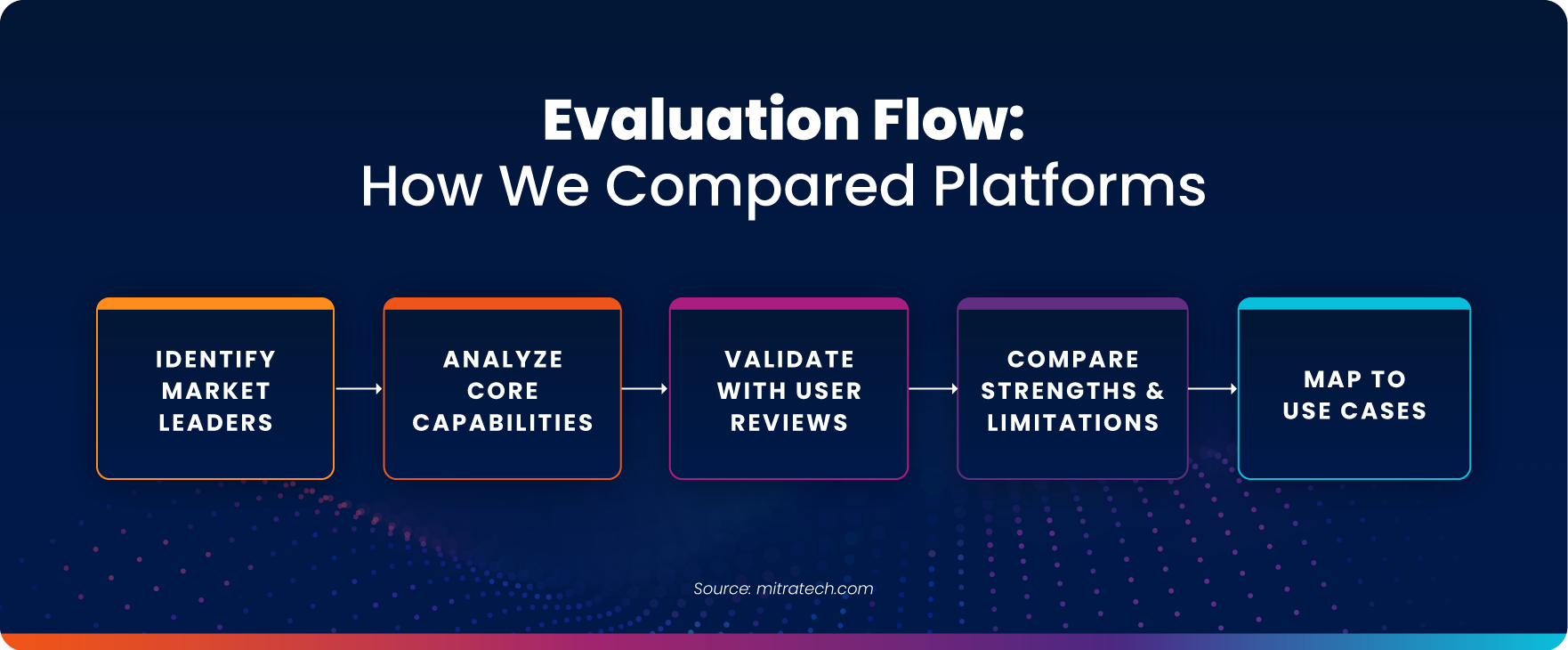
Each platform was assessed using publicly available product documentation, analyst commentary from Gartner and Forrester where available, and verified user reviews from G2, Capterra, and Gartner Peer Insights. No paid placement or vendor sponsorship influenced the rankings or ratings cited. Ratings sourced from third-party review platforms are noted by source.
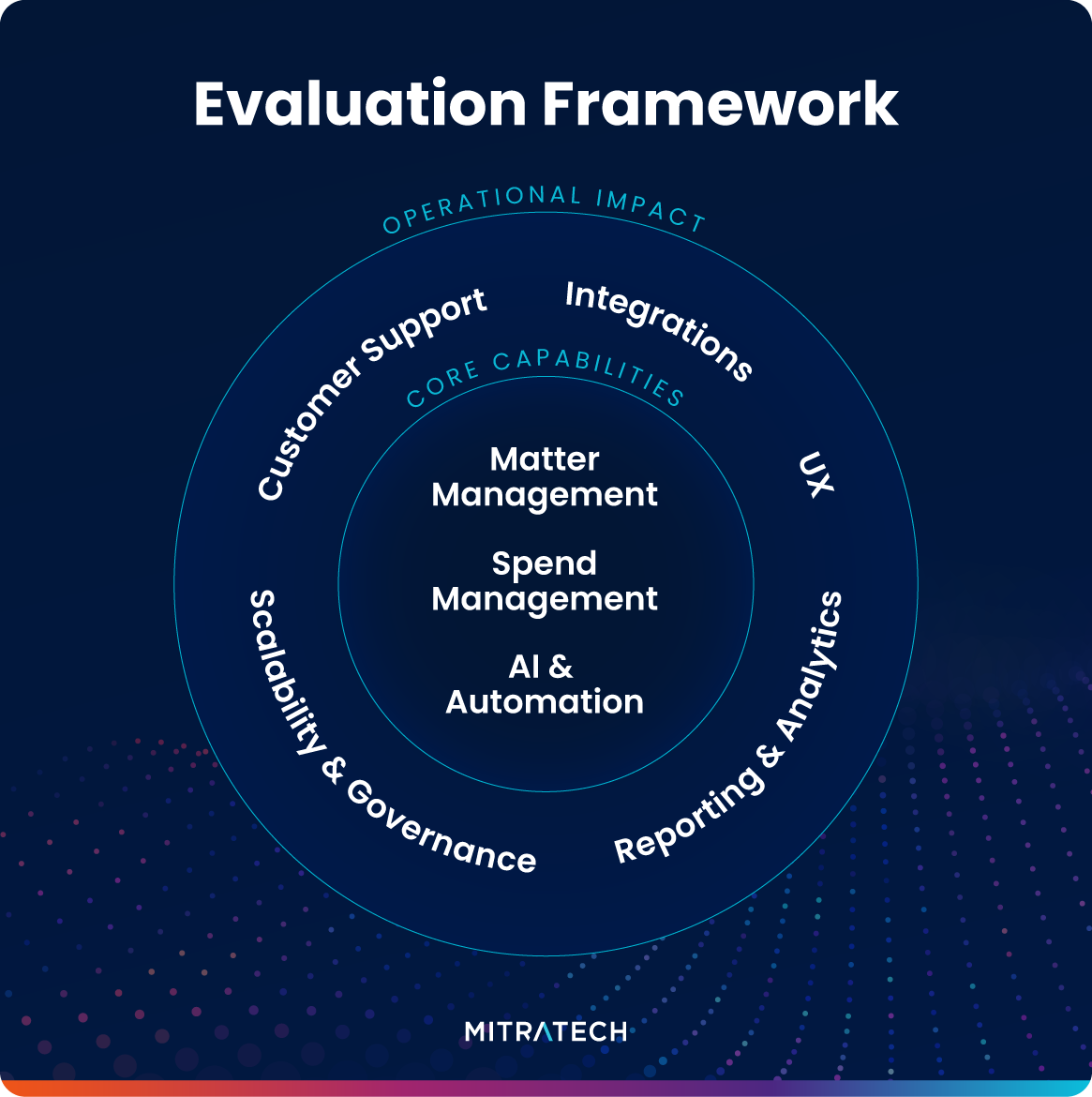
Matter Management Capabilities: Intake, routing, lifecycle tracking, and matter organization across practice areas and geographies.
Legal Spend Management & E-Billing: Invoice review, billing guideline enforcement, budget tracking, accruals, and outside counsel spend visibility.
Workflow Automation & AI: AI-powered invoice review, matter classification, document processing, and process automation capabilities.
Integrations & Ecosystem Fit: Compatibility with ERP, HRIS, CLM, DMS, compliance, and risk tools relevant to the organization.
Scalability, Governance & Configurability: Ability to model complex workflows, support global operations, and maintain audit-ready governance.
Reporting & Analytics: KPI dashboards, spend analytics, vendor performance tracking, and executive-ready reporting.
Ease of Use & User Experience: Onboarding speed, training requirements, UI quality, and custodian/vendor adoption friction.
Customer Support & Success: Quality of ongoing support, implementation services, and customer success engagement as reported by verified users.
The 13 Best Enterprise Legal Management Software Platforms for 2026
Our insights are based on publicly available product documentation, vendor websites, and industry comparison resources. Mitratech acknowledges that competitors may update their products or terms at any time. All trademarks, service marks, and company names are the property of their respective owners. Use of these names does not imply any affiliation with or endorsement by them.
The following vendor evaluations are listed in no particular order.
-
Mitratech ELM (TeamConnect)
Best for: Enterprise legal teams seeking end-to-end visibility and control across matters, spend, and workflows
Shaped by more than 30 years of co-innovation with legal operations professionals, Mitratech TeamConnect is Mitratech’s flagship ELM platform built for in-house legal departments operating in complex, evolving environments. It consolidates matter management, e-billing, legal spend, document automation, workflow automation, and reporting into a single system of record, serving enterprises and mid-market organizations across 160+ countries.
Unlike systems that require legal teams to adapt to predefined workflows, TeamConnect allows organizations to configure workflows, data models, and reporting structures to reflect how they actually work (without custom code and without heavy IT dependence). Every release delivers enhancements driven directly by customer requests, supported by a highly engaged user community in which practitioners share best practices and influence the product roadmap.
What sets TeamConnect apart in 2026 is how AI is delivered: not as a bolt-on chatbot, but as ARIES™, an AI ecosystem woven directly into the platform where legal work already lives. While general-purpose AI tools operate on short-term memory — reasoning only from what’s been given to them in a session — ARIES™ has long-term memory. It draws on your complete history of matters, spend, invoicing, outside counsel performance, and workflows, regardless of time or complexity. That’s the difference between AI that generates an answer and AI that already knows your organization well enough to ask the right question.
Critically, every ARIES™-assisted action operates within your existing governance controls, audit trails, and compliance configurations (not around them). For legal teams under pressure to scale AI without sacrificing accountability, that’s not a feature. It’s the foundation.
- Deep configurability without custom code — tailor workflows, data models, and reporting to your processes
- Enterprise-grade matter and spend management supporting complex portfolios, multiple stakeholders, and global operations
- ARIES™ AI capabilities: ambient AI that surfaces relevant context without manual search, and on-demand AI that executes tasks, including matter creation from documents, docket timeline generation, invoice line item review, natural language spend queries, and intelligent matter closure
- Legal spend management with real-time invoice visibility, billing guideline compliance, vendor performance tracking, and international vendor support
- Reporting and dashboards for spend trends, matter performance, workload distribution, accruals, and operational KPIs
- Workflow automation and integrations with Outlook, Salesforce, LegalHold, Microsoft 365, and more to reduce manual effort and maintain connected workflows
- Governed, auditable AI by design: Every AI-assisted action inherits your permissions and configurations, holding up under audits, reviews, and legal scrutiny
“TeamConnect is a highly affordable, customizable ELM application. It serves all the legal matter management needs of an organization. The features include high scalability, powerful API, and intuitive user interface. It has shown excellent results when used for managing more than a billion records.” — Verified reviewer, G2
“TeamConnect integrates well with our systems and is very user-friendly. It helps make our invoicing process much more efficient and our billing data much easier to navigate.” — Verified reviewer, Capterra
Strengths Considerations Highly configurable for complex/global programs Optimized for enterprise scale; may exceed smaller teams’ needs ARIES™ AI embedded in the system of record — not layered on top of it UI noted as an area for improvement by some users Governed, auditable AI that operates within compliance controls by design Requires established legal ops practices to maximize value Flexible integrations across the platforms and systems legal teams already use Strong scalability for high-volume environments Part of a broader Mitratech ecosystem Key takeaway: TeamConnect is the go-to for large enterprises seeking end-to-end ELM with deep configurability, spend control, and AI that operates within (not outside) your governance framework. It’s not just a system of record. It’s becoming a system of intelligent action.
-
Onit
Best for: CLM-focused legal transformation initiatives.
Onit is frequently selected by organizations where contract lifecycle management is the primary driver of legal transformation. Its platform emphasizes workflow configuration and contract process automation, with matter and spend functionality serving as supporting modules. SimpleLegal (now part of the Onit suite) extends this reach into mid-market e-billing and spend management.
- Contract lifecycle management (CLM) as the core workflow
- No-code workflow configuration and legal intake automation
- Matter and spend management (via OnitX and SimpleLegal)
- ERP and business system integrations
- Reporting dashboards and operational analytics
Strengths Considerations Contract-forward architecture for CLM-primary orgs Matter/spend modules are supporting, not primary Broader platform via SimpleLegal integration Onboarding complexity noted by some users Key takeaway: Onit is a strong fit when contract standardization and intake automation are the primary goals. Teams needing enterprise-wide ELM beyond contract workflows should evaluate the depth of supporting modules carefully.
-
SimpleLegal
Best for: Mid-market legal teams prioritizing usability and fast deployment.
SimpleLegal is now part of the Onit ELM suite, positioned as an AI-native e-billing and spend management solution that combines accessible functionality with intuitive design. It is a common first ELM deployment for growing legal departments building formal operations processes for the first time.
“The approval process was easy to set up, easy to maintain and for our external vendors to implement.” — Verified reviewer, Gartner Peer Insights
Strengths Considerations Fast deployment; minimal IT friction Reporting depth noted as an area for improvement Strong ERP and finance system integrations Less suited for highly complex workflow branching Onboarding/integration can feel lengthy for some teams Key takeaway: SimpleLegal delivers usability and spend visibility for mid-market teams. Those requiring deep enterprise configurability may need to evaluate whether it scales to long-term operational needs.
-
LexisNexis CounselLink
Best for: Organizations standardized on LexisNexis and seeking integrated legal research with ELM.
LexisNexis CounselLink is a premier cloud-based legal management solution from LexisNexis, frequently selected by legal departments already embedded in the LexisNexis ecosystem. For organizations that prefer alignment between legal research tools and spend management systems, this integration can simplify vendor consolidation. CounselLink now includes CLM capabilities via CounselLink+ with AI-powered contract analytics.
On G2, LexisNexis CounselLink earns a quality of support score of 9.3, with users specifically praising the responsiveness and expertise of the support team. Its matter management feature scores 8.9, noted for providing comprehensive visibility across legal matters.
- Matter management and eBilling in a single platform
- Vendor benchmarking and rate analytics
- CLM via CounselLink+ with AI contract data extraction
- Integration with LexisNexis research platforms
- Policy enforcement and compliance dashboards
Strengths Considerations Quality of support rated 9.3 on G2 Contract management feature scored lower by G2 reviewers Strong matter management visibility Best value for LexisNexis-committed environments Native LexisNexis research integration Key takeaway: Compelling for organizations already in the LexisNexis ecosystem. Teams prioritizing cross-platform extensibility should compare ecosystem flexibility alongside the research integration benefits.
-
Brightflag
Best for: Basic AI-driven spend analytics.
Brightflag (recently acquired by Wolters Kluwer) is an AI-powered legal spend and matter management platform that is consistently recognized for its streamlined deployment model and customer support. On G2, it is ranked as the top alternative to both Thomson Reuters Legal Tracker and CounselLink, reflecting its strong position in the spend management category. Pricing is subscription-based on annual legal spend, with no per-user or per-vendor fees.
- AI-driven invoice review (PDF and LEDES)
- Automated timekeeper rate validation
- Budget tracking and accrual forecasting
- Vendor performance reporting and spend analytics
- Spend-based pricing model (no per-user fees)
“Our team spends less time on invoice processing and reporting, and more time on initiatives that directly support our company’s growth.” — Verified reviewer, G2 (organic review)
Strengths Considerations Easier to set up than SimpleLegal per G2 reviewers Less customization in reporting and dashboards Highly praised customer support team Structured configuration model limits workflow flexibility Strong AI invoice automation Not a full ELM suite for complex operations Spend-based pricing (which can be unpredictable) Recently acquired by Wolters Kluwer, which may affect long-term product focus and roadmap investment Key takeaway: Brightflag delivers fast deployment and strong AI-powered spend control. Teams requiring highly customized workflows or enterprise-level workflow branching should evaluate configurability carefully.
-
TyMetrix 360 (Wolters Kluwer)
Best for: Claims-intensive organizations prioritizing stability and established processes over large-scale transformation
TyMetrix 360 (Wolters Kluwer) is a long-standing SaaS ELM platform widely used in claims-heavy environments, particularly P&C insurance, where structured billing processes and consistent oversight of high-volume matters are critical. Its LegalVIEW benchmarking analytics provide access to one of the industry’s largest legal spend databases for rate and performance benchmarking.
- eBilling and spend management for high-volume matters
- Claims workflow management
- LegalVIEW® benchmarking analytics
- Budget forecasting and vendor rate tracking
Strengths Considerations Proven stability for claims-heavy environments Less suited for teams pursuing broader ELM transformation LegalVIEW benchmarking database Configurability and modern UI lag behind newer platforms Familiar to P&C insurance legal teams Part of a fragmented portfolio — one of three ELM solutions offered by Wolters Kluwer, which may affect long-term product focus and roadmap clarity Key takeaway: A dependable choice for claims-heavy organizations prioritizing stability. Teams evaluating broader platform strategies should assess how well it supports greater configurability and unified data visibility over time.
-
ServiceNow Legal Service Delivery
Best for: Organizations already standardized on ServiceNow seeking to align legal workflows with enterprise service management.
ServiceNow Legal Service Delivery is chosen primarily by organizations already operating the broader ServiceNow platform. It aligns legal intake and workflow orchestration with IT-driven enterprise service management frameworks, making it a natural extension for IT-led technology environments rather than a standalone ELM decision.
- Legal intake and self-service portals
- Workflow automation built on ServiceNow architecture
- Task and SLA tracking integrated with HR and IT systems
- Role-based dashboards and case tracking
Strengths Considerations Strong intake orchestration within ServiceNow ecosystems Limited legal-specific matter and spend depth No additional vendor relationship for ServiceNow shops BCM module is lightweight for mature legal programs Cross-functional routing and enterprise integration Less cost-efficient as a standalone ELM deployment Key takeaway: Valuable extension for ServiceNow-standardized enterprises. Legal departments seeking deep legal-specific matter and spend capabilities should evaluate purpose-built ELM platforms alongside it.
-
Legal Tracker
Best for: Simple eBilling where matter management is not a priority.
Legal Tracker is positioned as a focused eBilling solution for organizations whose primary goal is invoice management and spend visibility. It is typically evaluated by legal departments that do not require comprehensive matter management or cross-functional workflow orchestration. For teams seeking straightforward billing oversight, Tracker provides a targeted solution without the complexity of a full ELM suite.
- Invoice submission and review workflows
- LEDES file support and billing guideline enforcement
- Spend reporting dashboards and basic budgeting
- Vendor collaboration tools
Strengths Considerations Focused scope reduces deployment complexity Requires HighQ integration for complete matter management, collaboration, and workflows Good fit for billing-primary use cases Organizations centralizing full legal ops will need additional systems Key takeaway: Right-sized for billing oversight. Not the right choice if you’re planning to centralize end-to-end legal operations.
-
Filevine
Best for: Operational legal teams managing high-volume, repeatable case workflows.
Filevine is frequently adopted in environments managing large volumes of operational legal work, including personal injury, insurance defense, and high-throughput case management. Its collaboration tools and document-centric workflows support teams that handle repeatable case processes at scale, and it is ranked by G2 as the top overall alternative to TyMetrix 360.
- Case and matter management with workflow templates
- Document management and team collaboration
- Task automation and client communication portals
- Reporting dashboards for operational throughput
Strengths Considerations Strong for high-volume, repeatable case types Not designed for enterprise-wide governance extensibility Collaboration and document management well-rated Less suited for complex spend management or global legal ops Workflow templates accelerate deployment Key takeaway: An operational workhorse for high-volume case environments. Teams prioritizing enterprise governance, spend visibility, or cross-functional ELM should look at full-suite alternatives.
-
Ironclad
Best for: Enterprises driving AI-powered contract execution and approval automation at scale.
Ironclad is a dedicated contract lifecycle management platform recognized as a Leader in both the 2025 Gartner Magic Quadrant for CLM and the Forrester Wave Q1 2025 for Contract Lifecycle Management Platforms. It carries a 4.5/5 rating on G2 and 4.4/5 on Capterra. Customers include L’Oréal, OpenAI, Mastercard, Cisco, and Dropbox. Its AI assistant, “Jurist,” handles contract review, risk scoring, and clause analysis.
- Contract workflow automation with conditional approval routing
- AI Jurist: automated review, risk scoring, clause analysis
- Native e-signature and deep Salesforce integration (multi-org)
- Digital playbooks and contract repository with search
- Gartner Magic Quadrant CLM Leader (2023, 2024, 2025)
Strengths Considerations Deep Salesforce integration for sales-driven contracting Steep learning curve for administrators new to CLM AI-powered contract execution at scale Data visualization/insights feature needs maturation Enterprise pricing can be significant ($60K+ starter tiers) Primarily CLM, not a full ELM suite Key takeaway: Ironclad is the leading choice for organizations that need AI-powered contract execution, approval automation, and Salesforce-integrated CLM at enterprise scale, and is regularly recognized by Gartner and Forrester as a category leader.
-
Sirion
Best for: Supplier obligation tracking and post-signature contract performance management.
Sirion is an AI-native CLM platform built on an agentic architecture, with particular strength in the post-signature phase of contract management. Its extraction agents build a semantic data layer from legacy and third-party contracts, enabling obligation monitoring and supplier performance oversight that extends well beyond what most contract creation tools offer. It is frequently evaluated in procurement-heavy contracting environments.
- AI-native contract extraction and obligation tracking
- Supplier performance monitoring dashboards
- Post-signature contract analytics and risk tracking
- Procurement system integrations
Strengths Considerations Industry-leading post-signature obligation management Depth is in obligation management, not full ELM Strong fit for procurement and supplier-heavy orgs Less suited for contract creation-focused workflows Key takeaway: Sirion’s post-signature focus distinguishes it within contract-intensive industries. It pairs well with creation-focused CLM tools rather than replacing them.
-
Everlaw
Best for: Litigation-heavy legal teams needing cloud-native eDiscovery and document review.
Everlaw is a cloud-native litigation and investigation platform frequently implemented alongside ELM systems to support litigation workflows. It is not a full enterprise legal management suite, but earns a place on this list because litigation exposure is a primary driver of ELM selection for many organizations. In G2’s Fall 2025 Grid Reports, Everlaw was named the #1 eDiscovery vendor for the third consecutive quarter, with a verified customer rating of 4.7/5 and a legal hold satisfaction score of 89 (above all competitors).
- eDiscovery and legal hold management (G2 #1 Fall 2025)
- Cloud-native document review with AI analytics
- Trial preparation and case collaboration tools
- Transparent per-GB pricing
Strengths Considerations Cloud-native eDiscovery and document review Not a full ELM suite; litigation-specific Transparent per-GB pricing Advanced AI features have a learning curve Key takeaway: The clear choice for litigation-heavy teams. Most organizations will deploy Everlaw alongside (not instead of) a core ELM platform.
How to Choose the Right ELM Solution
The right ELM platform depends on where your legal department sits on the maturity curve, what your primary operational pain point is, and which systems you need to connect. A few principles help narrow the field:
- Match the tool to program maturity. Foundational teams starting with formal legal operations benefit from platforms like SimpleLegal or Brightflag that deploy quickly with minimal IT overhead. Growing teams adding matter management and workflow automation will find Onit or Filevine well-suited. Enterprise programs managing complex global operations, multi-system governance, and high volumes of matters need the configurability and integration depth of platforms, such as Mitratech TeamConnect, CounselLink, or Thomson Reuters Legal Tracker.
- Prioritize AI and automation where volume is highest. Every platform in this guide includes some AI capability, but the depth varies significantly. Brightflag and Mitratech’s InvoiceIQ excel at invoice automation. Ironclad and Sirion lead in contract AI. Evaluate where your team currently loses the most time to manual processing—and choose accordingly.
- Check integration requirements carefully. Look for pre-built connectors to your ERP, HRIS, CLM, document management system, and compliance tools—not just API availability. The difference between a surface-level connector and a deep bidirectional integration determines whether data actually stays in sync.
- Define primary use case: spend control, matter management, CLM, litigation, or full ELM
- Assess program maturity: foundational, growing, or enterprise
- Map integration requirements: ERP, HRIS, CLM, DMS, compliance tools
- Evaluate AI depth where processing volume is highest
- Confirm reporting needs for quarterly and annual board reporting
- Assess governance and configurability for complex workflow requirements
- Request demos with realistic data, not vendor-prepared scenarios
- Check verified reviews on G2, Capterra, or Gartner Peer Insights before shortlisting
Why ELM Software Matters More in 2026
Regulatory complexity is accelerating. Frameworks including DORA, GDPR, HIPAA, and the EU AI Act require legal teams to maintain auditable processes, consistent controls, and centralized records. Organizations unable to produce documentation trails on demand face increasing regulatory exposure—a burden that manual processes and disconnected tools cannot reliably absorb.
Cost pressure is intensifying. Boards and finance teams are scrutinizing legal spend with more rigor than at any previous point, driving demand for billing guideline enforcement, rate benchmarking, accrual accuracy, and vendor performance analytics. ELM platforms that can demonstrate measurable spend reduction are increasingly treated as business-critical infrastructure, not departmental tooling.
Cross-department collaboration is now expected. Legal increasingly interacts with HR, Compliance, Procurement, Finance, and Risk in real time. ELM solutions that integrate with those systems (rather than operating as a silo) enable faster decision-making and reduce the administrative overhead of manual data transfers between departments.
AI is shifting the baseline. Invoice automation, matter classification, contract risk analysis, and predictive spend forecasting are no longer differentiating features—they are becoming table stakes. Platforms that haven’t invested meaningfully in AI capabilities are falling behind the operational efficiency expectations of modern legal departments.
Sources
- G2. Enterprise Legal Management (ELM) Software category — verified user reviews and Grid reports. g2.com
- Capterra. Mitratech TeamConnect reviews (2026). capterra.com
- Gartner Peer Insights. Corporate Legal Operations Technology market — verified user reviews. gartner.com
- Gartner Peer Insights. SimpleLegal reviews. gartner.com
- Gartner Peer Insights. Contract Life Cycle Management market — Ironclad CLM reviews. gartner.com
- Gartner Magic Quadrant for Contract Lifecycle Management (2025). Ironclad named Leader.
- Forrester Wave: Contract Lifecycle Management Platforms, Q1 2025. Ironclad named Leader.
- G2. Ironclad reviews (2026). g2.com
- G2. Brightflag reviews (2026). g2.com
- G2. Thomson Reuters Legal Tracker reviews (2026). g2.com
- G2. LexisNexis CounselLink vs. Thomson Reuters Legal Tracker comparison. g2.com
- Business Wire. G2 Ranks Everlaw #1 in Fall 2025 Reports for eDiscovery and Legal Hold Software (September 2025).
- Bind Legal. Best AI Tools for Legal Teams in 2026 — Ironclad profile. bindlegal.com
- rLegalTech. Ironclad vendor profile and community reviews (2026). rlegaltech.com
Compliance disclaimer:
Product descriptions are based on publicly available vendor documentation, verified third-party review platforms (G2, Capterra, Gartner Peer Insights), and industry analyst commentary. Features and capabilities may change over time. This article does not constitute an endorsement of any vendor or product. All trademarks and company names are the property of their respective owners. Organizations should conduct their own due diligence, including product demonstrations and reference checks, before making purchasing decisions. No statistics have been fabricated and no analyst rankings cited without direct attribution.