Corporate legal teams are under more pressure than ever. Budgets are tighter. Matter volumes are increasing. Regulatory scrutiny isn’t slowing down. And leadership expects legal to operate like a strategic business partner — not just a cost center.
That’s where enterprise legal management (ELM) software comes in.
But with so many vendors and platforms in the market, how do you know which solution actually delivers value?
If you’re evaluating enterprise legal management software, here are the five essential features you should prioritize — and why they matter.
Enterprise legal management (ELM) software helps corporate legal departments manage matters, legal spend, contracts, workflows, and reporting in one centralized system.
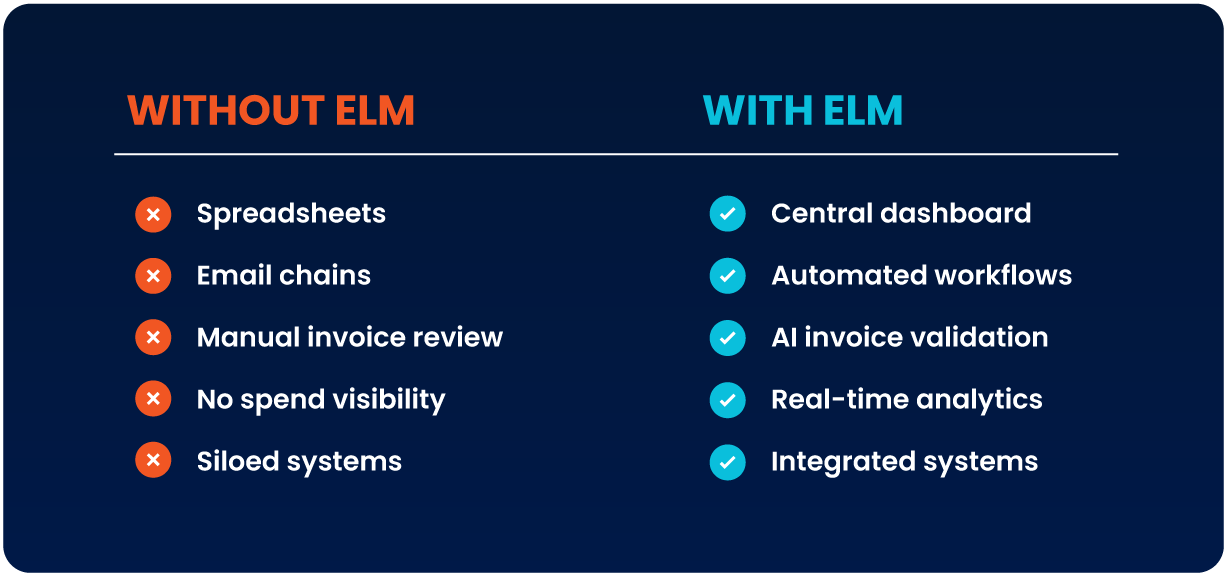
Instead of relying on spreadsheets, email chains, and disconnected tools, ELM systems provide:
- Structured matter intake and tracking
- eBilling and legal spend management
- Workflow automation
- Legal hold process support
- Analytics and reporting dashboards
- Secure collaboration across teams
The goal? Greater visibility, improved efficiency, and smarter decision-making across legal operations.
Now, let’s break down what truly makes an ELM platform worth the investment.
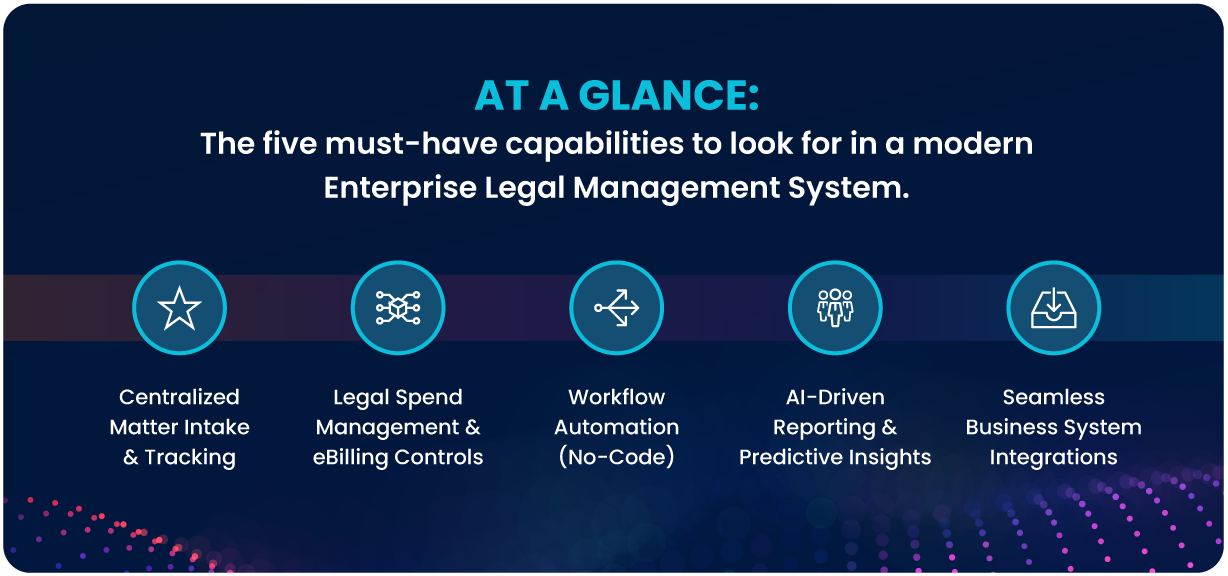
#1. Centralized Matter Intake & Tracking
Every legal request starts somewhere — often in an inbox.
A strong enterprise legal management system replaces scattered intake with structured, trackable legal matter intake processes. Look for:
- Configurable intake forms
- Automated routing and approvals
- Real-time matter status dashboards
- Centralized document storage
- Role-based permissions and audit trails
When matter intake is standardized, legal teams reduce manual errors, eliminate redundant follow-ups, and gain instant visibility into workloads across departments and geographies.
#2. Legal Spend Management & eBilling Controls
For many organizations, outside counsel spend represents one of the largest legal cost drivers. Enterprise legal management software should give you control — not just visibility.
Essential capabilities include:
- Automated invoice review
- Billing rule enforcement
- Timekeeper rate validation
- Budget tracking and forecasting
- Spend analytics dashboards
Advanced platforms also use AI to flag anomalies, duplicate charges, or non-compliant billing entries before invoices are approved.
The result? Better cost containment and improved outside counsel accountability.
#3. Workflow Automation
Legal teams repeat structured processes every day — NDA approvals, contract reviews, compliance sign-offs, legal holds.
Modern ELM software should streamline those workflows rather than slow them down. Prioritize platforms that offer:
- Drag-and-drop workflow builders
- Conditional logic and parallel routing
- Automated reminders and escalations
- SLA tracking
- No-code configuration for legal ops teams
No two legal departments operate exactly the same way. A customizable workflow engine ensures your technology adapts to your processes — not the other way around.
#4. AI-Driven Reporting & Predictive Insights
AI in legal technology isn’t hype — it’s quickly becoming a baseline expectation.
The most effective enterprise legal management systems now incorporate AI and machine learning to support:
- Invoice anomaly detection
- Predictive workload forecasting
- Contract trend analysis
- Automated executive reporting
- Risk pattern identification
AI enhances — rather than replaces — legal decision-making by identifying patterns across large data sets that would otherwise take hours to analyze manually.
For legal leaders, this means shifting from reactive reporting to proactive strategy.
#5. Seamless Integrations Across Business Systems
An ELM system shouldn’t operate in isolation.
True enterprise legal management software integrates with the broader business ecosystem. High-value integrations often include:
- ERP and Accounts Payable systems
- CRM platforms
- Document management systems
- HR systems
- Claims platforms
- IP management systems
When systems communicate, data flows cleanly. That eliminates duplicate entry, reduces errors, and improves collaboration across finance, compliance, and operations teams.
Why These Enterprise Legal Management Software Features Matter
When combined, these five capabilities help legal teams:
- Reduce administrative burden
- Improve outside counsel cost control
- Increase operational transparency
- Strengthen compliance and defensibility
- Support strategic, data-driven decisions
In short, the right ELM software enables legal departments to scale without increasing headcount — and to demonstrate measurable business value.
Choosing the Right Enterprise Legal Management Software
Selecting the right ELM platform requires balancing usability, configurability, security, and scalability.
As you evaluate options, ask:
- Can this system scale globally?
- How customizable are workflows?
- What AI capabilities are native?
- How robust are reporting tools?
- Does it integrate with our existing tech stack?
The best enterprise legal management software doesn’t just organize your work — it empowers your team to operate more strategically. Enterprise legal departments are evolving. The technology supporting them should evolve, too.
If you’re exploring how modern ELM solutions can streamline operations, improve cost control, and drive better business outcomes, now is the time to evaluate whether your current systems are built for what’s next.
Frequently Asked Questions About Enterprise Legal Management Software
What features should enterprise legal management software include?
At a minimum, ELM software should provide matter management, legal spend and eBilling controls, workflow automation, reporting and analytics, and integrations with finance and document systems.
What’s the difference between ELM and basic matter management software?
Matter management tools primarily track legal work. Enterprise legal management software goes further by incorporating spend controls, workflow automation, AI-driven reporting, and cross-system integrations.
Do all ELM platforms include AI capabilities?
Not all. Modern ELM systems increasingly integrate AI features such as invoice review automation, predictive analytics, and automated reporting — but capabilities vary by vendor.