

Legal technology adoption is already complex for in-house legal teams and law firms.
Aligning on solutions that work across both environments is even more challenging. A connected legal ecosystem helps address this by integrating systems, workflows, and data so teams can collaborate more effectively, improve visibility, and reduce inefficiencies across legal operations.
What is a connected legal ecosystem?
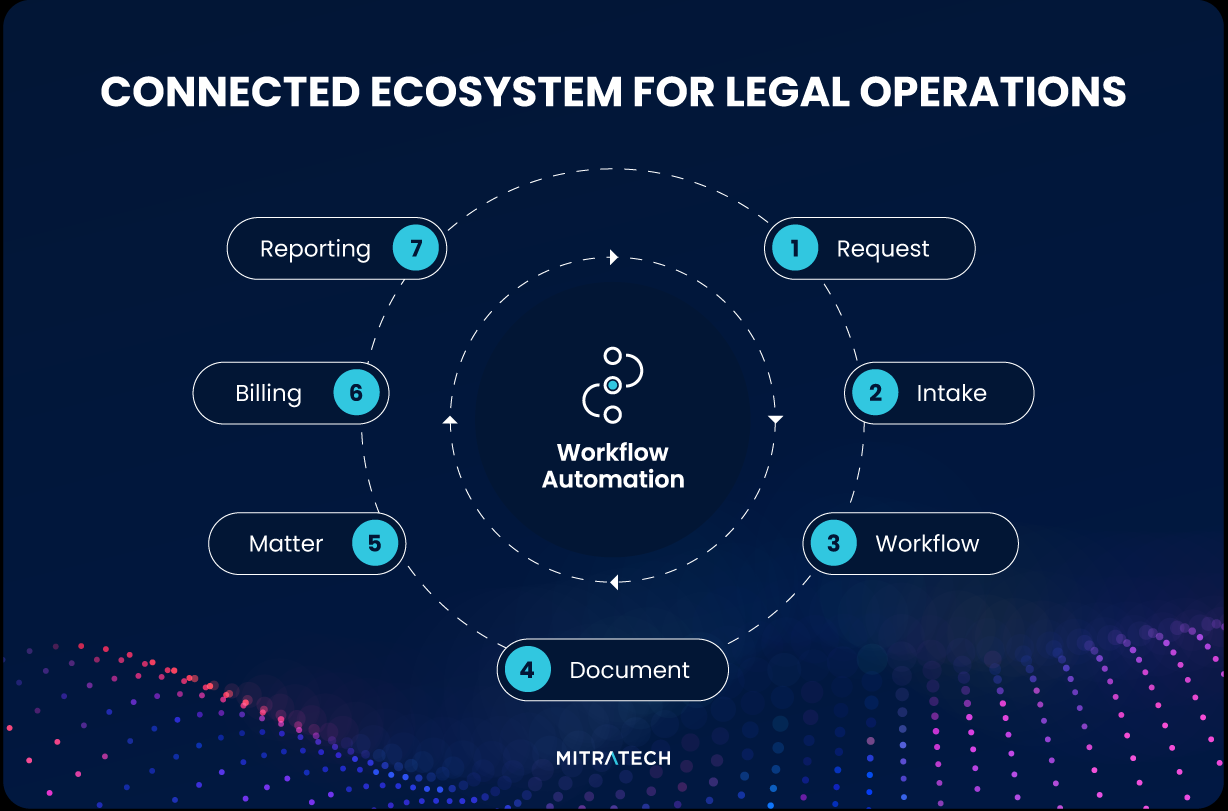
A connected legal ecosystem brings together the systems, tools, and processes used across legal operations into a more unified environment.
Instead of relying on disconnected tools, legal teams can integrate their technology so data flows more consistently between systems. This creates a more cohesive approach to managing legal work, from intake through resolution, while supporting collaboration between in-house legal teams and outside counsel.
To be more direct:
- A connected legal ecosystem integrates legal systems, workflows, and data across in-house legal teams and outside counsel
- It enables collaboration, improves visibility into processes, and reduces the need to manage multiple disconnected systems
- Legal workflow automation plays a key role by connecting tools and enabling consistent processes across the entire legal ecosystem
Why legal technology adoption creates challenges
Legal technology adoption for an in-house legal department or a law firm is already a challenge. The legal tech market is crowded, with hundreds of providers competing across different categories, making it difficult to select solutions that meet both internal needs and integration requirements.
For in-house legal teams and outside counsel, the challenge is not just choosing tools that serve their own needs, but selecting solutions that “play nice” with each other. Without alignment, teams often end up duplicating work across systems, reducing efficiency and visibility.
As one legal project manager explains, teams are often required to update multiple systems for the same case, creating unnecessary administrative work and increasing the risk of inconsistent data.
Where disconnected systems slow legal teams down
When legal systems are not connected, teams often face unnecessary friction in their day-to-day work.
For example, legal professionals may be required to update multiple systems for the same case. This leads to inefficiencies, inconsistent data, and additional administrative work that takes time away from higher-value legal tasks.
At the same time, limited visibility across systems makes it harder to track progress, understand performance, or improve processes across the legal ecosystem.
Connected vs. disconnected legal ecosystems
| Disconnected Legal Tech | Connected Legal Ecosystem |
|---|---|
| Multiple systems that do not integrate | Integrated systems connected through workflows |
| Duplicate data entry across tools | Single flow of data across systems |
| Limited visibility into legal processes | Improved visibility across in-house and outside counsel work |
| Manual coordination between teams | Standardized workflows across teams |
| Slower responsiveness and efficiency | Accelerated responsiveness and efficiency |
How legal workflow automation connects the legal ecosystem
Legal workflow automation is a foundational solution for connecting a legal ecosystem.
A workflow automation solution built on a platform- and device-agnostic SaaS architecture enables smooth API and connector-based integration across systems. This includes enterprise legal management platforms, case management systems, timekeeping tools, and eBilling software.
Because it connects systems rather than replacing them, workflow automation helps legal teams unify processes without disrupting existing technology investments.
As one experienced legal operations leader explains:
“One of the few solutions that can be used across the entire legal ecosystem, especially between the in-house legal teams and the law firms that help enable them.” — Connie Brenton, Chief of Staff/Senior Director of Legal Operations, NetApp
Key benefits of a connected legal ecosystem
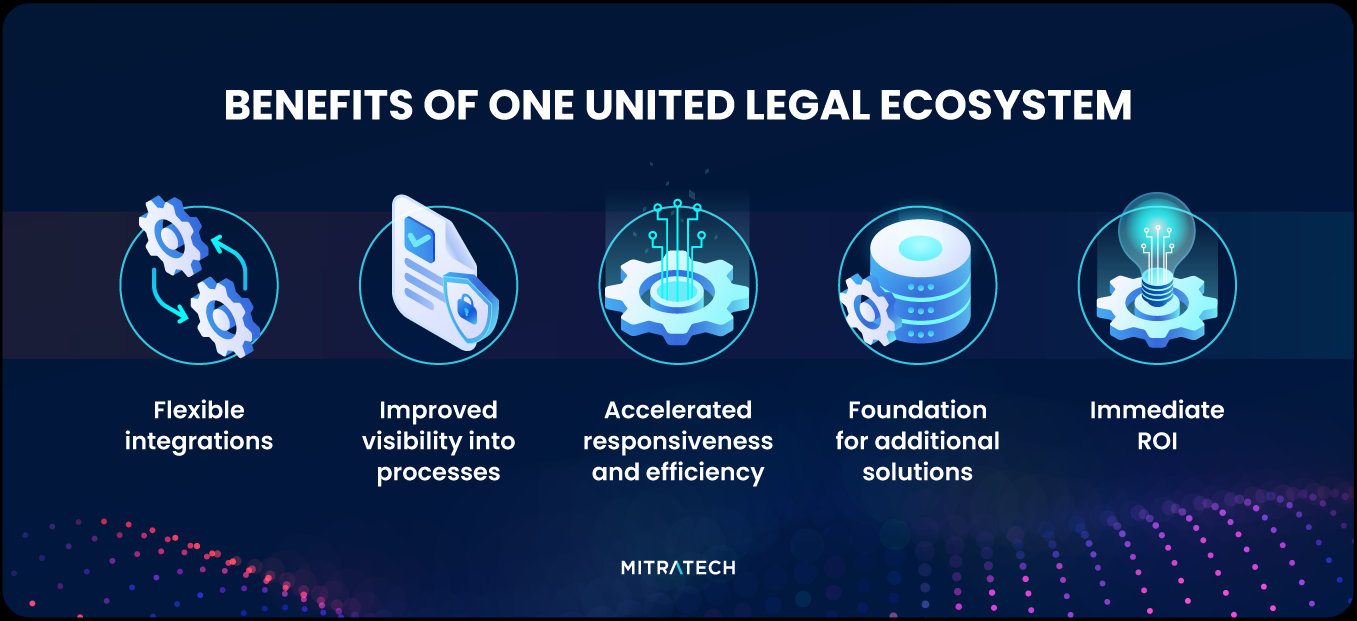
Implementing a connected legal ecosystem supported by workflow automation delivers measurable benefits across legal operations:
- Integration across the legal ecosystem that enables in-house legal teams and outside counsel to work more effectively together
- Improved visibility into processes across both internal and external legal work
- Accelerated responsiveness and efficiency for law firms and legal departments
- A foundation for additional solutions that can be added without disrupting existing systems
- Immediate ROI that helps justify future legal technology investment
How to build a connected legal ecosystem
- Evaluate existing legal technology – Identify the systems currently used across in-house legal teams and outside counsel.
- Prioritize integration over replacement – Focus on solutions that connect existing tools rather than requiring a complete overhaul.
- Implement workflow automation first – Establish a foundational layer that enables consistent processes and integration across systems.
- Standardize processes across teams – Align workflows so both sides can collaborate more effectively.
- Expand the ecosystem over time – Add additional solutions as needed, supported by the integration layer already in place.
A cornerstone of transformation and collaboration
A connected legal ecosystem is not built overnight, but it starts with a foundational approach.
By implementing workflow automation as a cornerstone technology, legal teams can create a more unified environment that supports collaboration, improves efficiency, and enables better decision-making across the legal ecosystem.
Rather than managing disconnected tools and processes, legal teams can move toward a more integrated, scalable model for legal operations.
Build a legal ecosystem that works across teams
Legal teams and law firms both want greater collaboration and efficiency, but achieving that requires solutions that work across both environments.
A connected legal ecosystem makes that possible by integrating systems, aligning workflows, and improving visibility across legal operations. With the right foundation in place, organizations can reduce complexity and create a more effective way to manage legal work.

FAQs
What is a legal ecosystem in legal operations?
A legal ecosystem is a connected environment where legal systems, workflows, and data are integrated to support collaboration, visibility, and efficiency across in-house legal teams and outside counsel.
How does workflow automation support a legal ecosystem?
Workflow automation connects systems and standardizes processes, enabling integration across tools and improving collaboration across the legal ecosystem.
Why is integration important in legal technology?
Integration reduces duplicate work, improves visibility into processes, and allows legal teams to work more efficiently across multiple systems.
Can in-house legal teams and law firms use the same systems?
They may use different systems, but integration enables those systems to work together more effectively within a connected legal ecosystem.
What is the first step to building a connected legal ecosystem?
Implementing a workflow automation solution provides a foundational layer that enables integration and consistent processes across systems.

