How to Implement AI in Your Legal Department Responsibly: The Practitioner's Go/No-Go Guide
A practical framework for legal operations professionals, general counsel, and in-house legal teams implementing AI responsibly
An Aligned Framework
with NIST AI RMF 1.0, ISO/IEC 42001:2023, and EU AI Act (Regulation 2024/1689)
Adopting AI in your legal department starts with governance. Without a defensible framework for data access, vendor oversight, and human review, AI tools create more risk than they reduce.
Even so, most legal AI implementations actually fail not because the technology didn’t work, but because the operating model didn’t change. AI affects how work enters the department, how it moves, how it is reviewed, and how decisions are made, and those changes require structure, not just software.
Liz Lugones, Mitratech’s VP of Value Experience and a recurring columnist in Today’s General Counsel, frames it this way: the shift that resolves the tension between moving quickly and protecting the organization is to stop treating AI adoption like a tool rollout and start treating it like an operating model change.
This guide gives legal operations teams a practical structure for making that change responsibly, covering go/no-go readiness, vendor evaluation, access controls, audit trails, data quality, and the emerging challenge of AI agents that can take autonomous actions.
Mitratech ARIES™ and Mitratech's broader AI solutions for legal teams
are built with these governance requirements embedded from the outset.
The Three Non-Negotiables of Legal AI Governance
Before any AI framework, process, or checklist, three rules apply without exception. These are drawn from Mitratech’s co-written AI Governance Checklist presented at CLOC Global Institute, and represent the minimum defensible standard for legal department AI use.
1. Use approved tools only for legal work.
Shadow AI, or tools adopted without IT or legal approval, is the fastest path to a privilege breach, a confidentiality violation, or a compliance failure. Before any AI use case goes live, confirm the tool is on your organization’s approved list. If no approved list exists, creating one is the first governance task.
How to Assess AI Readiness Before You Deploy: The Go/No-Go Framework
Most AI implementation failures are governance failures, not technology failures. The tool worked, but the AI use case wasn’t defined clearly enough, the inputs weren’t controlled, or the outputs weren’t reviewed before they caused a problem.
The following five-step framework, adapted from our Go/No-Go Readiness Checklist we co-presented at CLOC, gives legal operations teams a structured way to evaluate any AI use case before deployment.
Step 1: Define the use case explicitly. Identify the specific workflow, the users who will interact with the tool, and the document or data types in scope. Examples: contract review for NDAs over $500K, litigation research for employment matters, invoice review for outside counsel billing. Vague use cases produce vague governance. If you can’t explain the purpose, workflow, and user base in two sentences, the use case isn’t ready.
Step 2: Map your inputs. Identify what data will enter the AI tool and flag sensitive categories upfront — privileged communications, personal data, confidential business information, trade secrets. Confirm those categories are approved for that specific tool. Apply the minimum necessary principle: only include what’s needed, redact where possible.
Step 3: Control your outputs. Define who reviews AI outputs before they are relied on, acted on, filed, sent to a counterparty, or published externally. Every external-facing output — court filing, regulatory submission, client communication — requires a defined, documented approval step. That approval step is what makes the output defensible.
Step 4: Understand your vendor’s data practices. Know where your data is processed and stored, how long it is retained, and how it is deleted. Verify the full subprocessor chain — not just the primary vendor, but every third party they engage to deliver the service. Confirm that contract terms extend confidentiality, data handling, and incident notification obligations through that entire chain.
Step 5: Confirm EU AI Act classification if applicable. If the tool is used in any context involving EU-established individuals — employees, counterparties, or data subjects located in the EU — assess whether it qualifies as a high-risk AI system under Annex III of EU Regulation 2024/1689. If high-risk classification applies, confirm the vendor’s conformity obligations under Articles 9–17 and your own deployer obligations under Article 26, including maintaining logs, ensuring human oversight, and informing affected individuals where required.

What to Look for When Evaluating AI Vendors for Legal Use
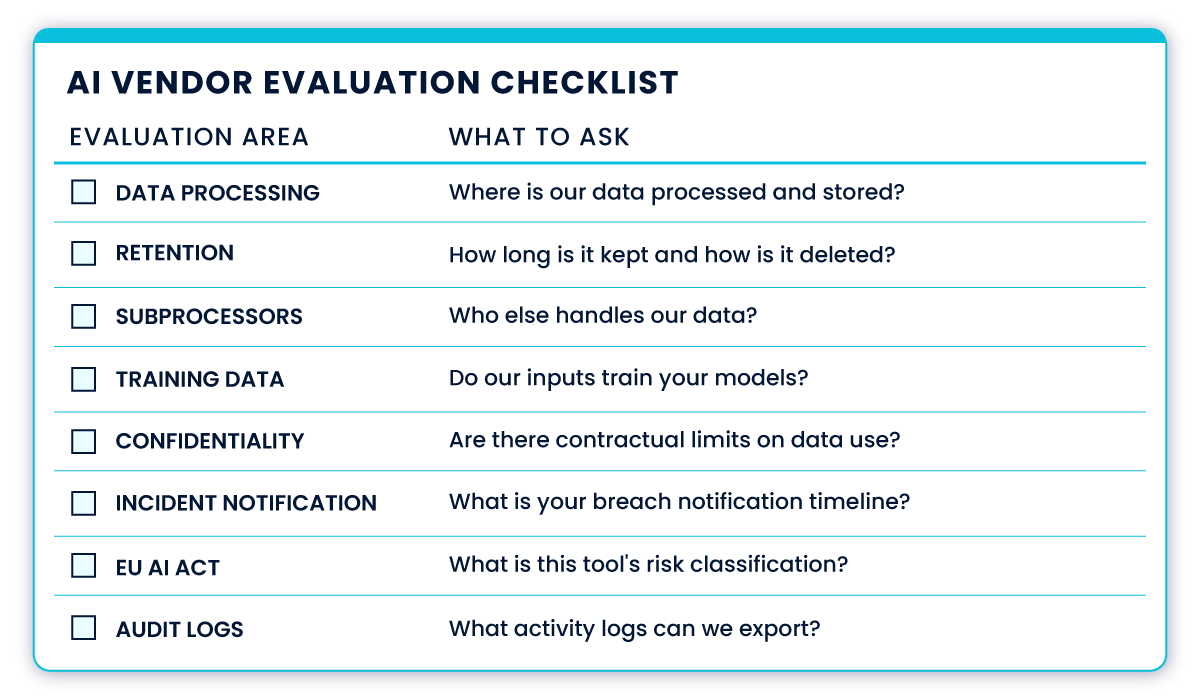
Vendor evaluation for legal AI is a distinct discipline from standard software procurement. The questions that matter most are not about features; they are about data handling, liability, and compliance. Use this evaluation framework for every AI vendor your legal team considers.
Data processing
Where is our data processed and stored? Which jurisdictions?
This table is a starting point for the contract and security review that should precede any legal AI deployment. Answers that are vague, incomplete, or contractually unenforceable are red flags.
Mitratech ARIES is purpose-built for legal department use, with data handling practices, access controls, and audit capabilities designed to meet enterprise legal governance requirements. Explore Mitratech’s AI and automation solutions for legal teams for more detail on how these capabilities are implemented.
Access Control: The Governance Layer Most Legal Teams Skip
Access control is the mechanism that enforces every other governance principle. It determines who can use which AI tools, with which data, under which permissions. Without it, approved tool lists and sensitive data policies are aspirational rather than operational.
Three access control principles matter most for legal AI governance.
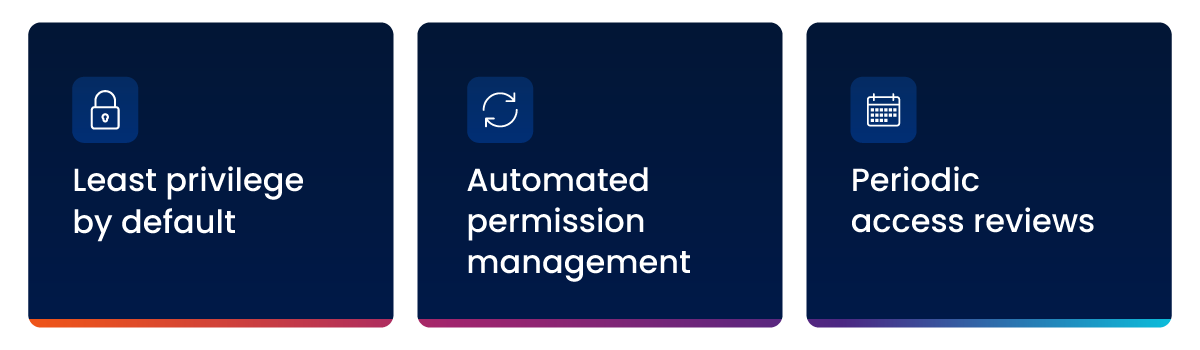
Least privilege by default. Every user should have access only to the data and capabilities they need for their specific role. Nothing more. In AI tools, this means configuring role-based permissions that limit data sources, output types, and agent capabilities based on the user’s function. A paralegal reviewing contracts should not have the same AI access as a partner reviewing litigation strategy.
Automated permission management tied to HR systems. Manual access management breaks down at scale and during transitions. Permissions should update automatically based on your systems of record: hire, role change, and termination events in tools like Workday or Oracle should trigger corresponding access changes in your AI platforms without requiring manual IT tickets. This is the difference between access control as a policy and access control as an operational reality.
Periodic access reviews for sensitive systems. Especially for AI tools with access to privileged communications or confidential business information, scheduled reviews of who has access (and why) should be part of your quarterly governance cadence. Access that was appropriate six months ago may not be appropriate today.
Mitratech’s workflow automation platform TAP supports the automated permission workflows that make this level of access governance scalable across legal departments of any size.
Audit Trails: What "Defensible" Actually Means
Defensibility in legal AI is not a posture; it is a record. When a court, a regulator, or a client asks how an AI-assisted output was produced, reviewed, and approved, your answer is your audit trail.
An adequate audit trail for legal AI use must capture: who used the tool, what inputs were provided, what outputs were generated, what review steps were taken before the output was acted on, what settings or configurations changed, and key administrator actions. That record must be timestamped, tamper-evident, and accessible for the retention period required by your jurisdiction and matter type.
Manual compliance methods (like periodic surveys, self-certifications, ad hoc reviews) cannot produce this level of evidence. They are retrospective and unreliable. Automated audit logging is the only approach that scales and holds up under scrutiny.

Four audit practices that should be embedded in your governance cadence:
-
Sample outputs regularly.
Review a representative sample of AI-generated outputs (especially external-facing work) for accuracy and policy compliance. This is not a one-time audit at launch; it is an ongoing quality control process.
-
Review access logs for anomalies.
Unusual access patterns, unexpected administrator changes, and off-hours usage are signals worth investigating. Your audit logs only protect you if you actually review them.
-
Track incidents and near-misses.
Document every AI-related issue (like data handling concerns, output errors, unauthorized use, compliance flags) along with what was fixed and what changed. Incident response processes will differ by organization, but the documentation requirement is universal.
-
Confirm data freshness.
AI is only as current as its sources. Verify regularly that data refresh jobs have succeeded, that source systems are connected and current, and that no AI tool is pulling from stale, deprecated, or draft content.
AI Agents: Extra Guardrails for AI That Takes Actions
Standard AI governance applies to tools that assist humans in producing outputs. AI agents are different. They can take actions directly: sending emails, creating tickets, updating records, routing approvals, and triggering workflows. The governance requirements are higher because the consequences of a mistake are harder or impossible to reverse.
Four guardrails are non-negotiable for legal department AI agents.
Narrow permissions by design.
AI agents should not have broad mailbox access, unrestricted drive access, or the ability to interact with systems beyond their specific function. Permissions should be configured as narrowly as possible, and reviewed regularly to confirm they remain appropriate.
Data Quality: AI Is Only as Good as Its Source
Every AI governance framework eventually comes back to data. The sophistication of the model matters less than the quality of the information it draws from. An AI tool operating on stale, inconsistent, or inaccurate data will produce stale, inconsistent, or inaccurate outputs, and those outputs will carry the appearance of authority because they came from an AI system.
Six data quality dimensions apply to every source your AI tools access:
Accurate. Does the data correctly reflect reality? Are the contract terms in your matter management system the actual signed terms?
Complete. Are all required fields populated? Are there gaps that would cause an AI tool to draw incorrect inferences from missing data?
Consistent. Is the same information represented the same way across systems? Inconsistent naming conventions, date formats, and terminology create confusion that propagates through AI outputs.
Up to date. When was this data last reviewed and refreshed? Is there a defined cadence for updates, and is someone accountable for maintaining it?
Rule-compliant. Does the data follow your organization’s defined formats, taxonomies, and governance rules?
No duplicates. Are there conflicting versions of the same record? Duplicate data is one of the most common causes of AI output errors in legal contexts.
For each source your AI tools access — contract management system, matter management platform, billing data, document repository, internal knowledge base — define a source of truth, name an owner, and establish a review schedule. AI should pull only from approved, published, reviewed content. Draft documents, unreviewed summaries, and deprecated pages should be explicitly excluded.
When a major system change occurs (like an upgrade, a field rename, a platform migration), trigger a review to confirm your AI tools are not relying on stale or broken connections.

The AI Governance Checklist for Legal Departments
The following checklist synthesizes Mitratech's framework, which was co-presented at CLOC Global Institute. It is organized by workflow stage — before adoption, before go-live, ongoing, for AI agents specifically, and embedded in your processes — rather than by governance category, which is how most checklists are structured but not how most teams actually work.
Before you adopt any AI tool
- Use case defined — workflow, users, and document types documented in two sentences or less
- Sensitive data categories identified and mapped to approved tools
- Vendor data practices reviewed — processing location, retention, deletion, subprocessors
- Contract terms confirm confidentiality and restrict training use of your data
- EU AI Act classification confirmed if tool touches EU-established individuals
- Access controls scoped — least privilege configured, role-based permissions defined
- Approved tool list updated to include this tool (or use case rejected)
Frequently Asked Questions

What are the most practical AI applications for in-house legal teams?
The most defensible AI applications for in-house legal teams start with clearly bounded, auditable use cases: contract review and drafting assistance, legal research and case analysis, invoice review and billing compliance, and compliance monitoring. Mitratech ARIES is purpose-built for legal department AI, providing AI assistance within a governed, audit-ready environment that keeps legal teams in control of every output and every action taken.
What AI tools help with legal compliance monitoring?
AI tools for legal compliance monitoring should provide real-time oversight of workflows, flag policy exceptions, maintain immutable audit logs of every action taken, and generate the documentation trail that courts and regulators increasingly expect. Mitratech’s AI solutions for legal teams include built-in compliance monitoring capabilities — tracking AI usage, logging outputs, and providing the audit evidence needed to demonstrate reasonable oversight if challenged.
How is artificial intelligence changing corporate legal operations?
AI is shifting corporate legal operations from reactive to proactive, automating high-volume routine tasks such as contract drafting, invoice review, and research, freeing legal staff for strategic work, and enabling real-time compliance monitoring across the organization. The governance challenge is ensuring that adoption is defensible: approved tools, controlled data access, human oversight of outputs, and comprehensive audit documentation that holds up under scrutiny.
How can I implement best practices in legal operations management?
Best practices in legal AI implementation start with governance before adoption. Define your approved tool list, map sensitive data categories to approved tools, establish human review requirements for all external-facing outputs, configure role-based access controls, and enable audit logging from day one. The CLOC Global Institute’s AI Governance Checklist and Mitratech’s legal operations platform provide a practical framework for making these practices operational rather than aspirational.
How can I standardize legal processes across the organization?
Standardizing legal processes with AI requires a shared source of truth for each data and content type, consistent data quality standards — accurate, complete, current, and rule-compliant — and AI tools that pull only from approved and published content, never from drafts or unreviewed sources. Mitratech’s legal operations platform creates the foundation for this standardization across matter management, document automation, workflow automation, and compliance workflows.
Take the Next Step
AI governance is not a one-time implementation. It is a continuous practice, deeply embedded in how you onboard vendors, train users, review outputs, and respond to incidents. The organizations that get this right are the ones that build governance into their process from the start, not the ones that retrofit it after something goes wrong.
Explore → Mitratech ARIES™
See → AI and automation solutions for legal teams
Download → the CLOC Global Institute AI Governance Checklist
For a broader framework on building the people, process, and data conditions that make AI governance sustainable (not just compliant), Liz Lugones’ Legal Maxxing column in Today’s General Counsel is a useful companion to this guide.

Heading text
Sub heading text

©2026 Mitratech, Inc. All rights reserved.
©2026 Mitratech, Inc. All rights reserved.