Checklist
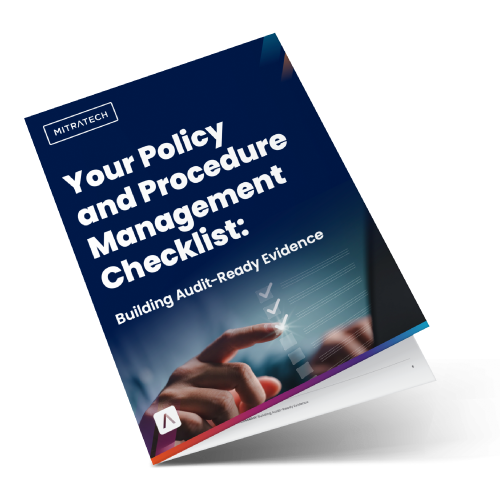
Your Policy and Procedure Management Checklist: Building Audit-Ready Evidence
Map owners, cadences, attestations, and exceptions into audit-ready, time-stamped documentation with the ultimate policy and procedure management checklist.
Cut approval time. Target the right audiences. Capture clean evidence your auditors will trust.
This checklist covers:
- A scorecard to help you spot gaps and prioritize fixes across governance, authoring, distribution, attestation, and reporting.
- An action plan that ties templates, routing rules, AI search, and attestations to measurable results.
- An evidence pack outline with “date received,” digital signatures, and exception tracking for audit-ready reports.
Ready to streamline your policy and procedure management while building proof into every step? Download the checklist or talk to an expert about applying it with our policy management solutions.
Case Studies: Policy and Procedure Management in the Real World
See how peers put organizational policies to work across complex environments.
-

HMSHost
HMSHost partnered with Mitratech for a cross-functional cleanup of policy and procedures. We helped inventory content, standardize naming and templates, and stand up a single, structured framework. The outcome: one authoritative source, clearer ownership, and fewer inefficiencies.
See the Results -
Frimely Park Hospital (UK NHS Foundation Trust)
Frimley Park moved from paper and SharePoint to a centralized way to share policies with 3,500 staff. With audit trails, reminders, assessments, and a login intercept for new starters, the Trust now proves who saw what and when while saving admin time.
See the Impact -
Allianz Ireland
Allianz Ireland needed proof of receipt and understanding under tighter regulatory scrutiny. With centralized distribution and short tests to measure comprehension, leaders can see both acceptance and scores across regions. Integration concerns were addressed, and early targets were exceeded.
See the Approach



FAQs on Policy and Procedure Management
What is policy and procedure management?
It is the lifecycle that turns organizational policies into daily practice. You define rules, author content, approve it, distribute to the right audiences, confirm understanding, and measure outcomes.
How is a policy different from a procedure?
A policy sets the rule and intent. A procedure explains the steps to follow. Good policy and procedures work together so people know both the what and the how.
How do we prove employees saw and understood a policy?
Track date received, require attestations, and add short knowledge checks. Keep signatures and exception approvals with the policy record for audits.
What KPIs show policy management is working?
Time to approve, acknowledgment rate, first-attempt quiz pass rate, exceptions closed within SLA, past-due reviews, and search no-result rate.
How often should policies be reviewed?
Use risk-based cadence. High-impact areas yearly. Lower-impact every 24–36 months. Trigger off-cycle reviews when laws or processes change.
You have the checklist. Now what?
Put policy and procedure management into motion with tools that enforce templates, route approvals, target distribution, confirm understanding, and produce audit-ready reports.

©2026 Mitratech, Inc. All rights reserved.

©2026 Mitratech, Inc. All rights reserved.