Matter management brings structure to that work by centralizing how legal matters, documents, workflows, and spend are tracked and managed.
As part of Enterprise Legal Management, it helps legal teams improve visibility, maintain control, and operate with greater consistency across the business.
In this Article:
What Is Matter Management?
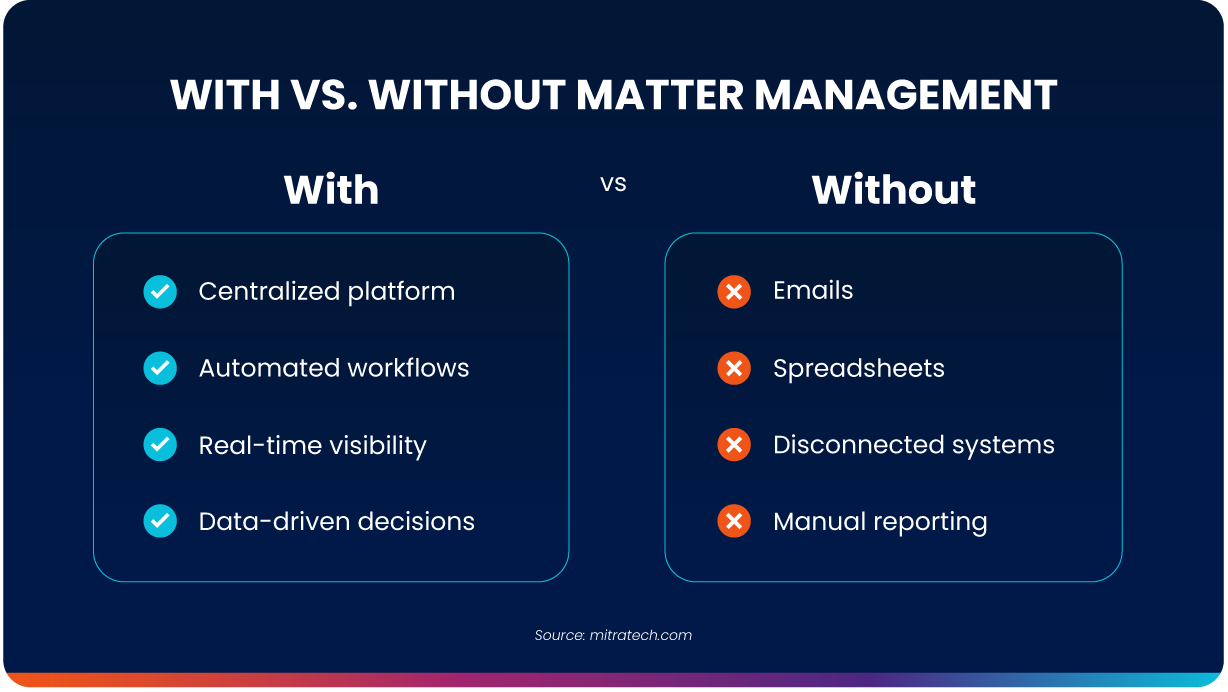
Matter management is the process of organizing, tracking, and overseeing all legal work — from intake to resolution — within a centralized system. It gives in-house legal teams real-time visibility into matters, budgets, documents, deadlines, and outside counsel, replacing fragmented spreadsheets and emails with a single source of truth. Effective matter management reduces legal spend, improves accountability, and enables data-driven decision-making across the entire legal department.
Instead of relying on emails, spreadsheets, and disconnected tools, it gives legal teams a single system to manage matters from start to finish. And with that single system, teams can:
- Track matters, documents, and tasks
- Manage legal spend and eBilling
- Collaborate with internal stakeholders and outside counsel
- Report on performance and make more informed decisions
At its core, it creates a single source of truth for legal operations.
The Slightly Longer Definition
Matter management is the capability within Enterprise Legal Management (ELM) to centralize and manage all legal matters across the organization. It provides the structure behind how legal work gets tracked, executed, and analyzed by enabling teams to:
- Capture and organize matter data consistently
- Manage documents, tasks, and workflows in one system
- Collaborate across legal, business teams, and external partners
- Report on legal activity, performance, and spend
Within an ELM platform, matter management serves as the operational foundation for visibility, control, and consistency across legal work.
What Is the Matter Management Lifecycle?
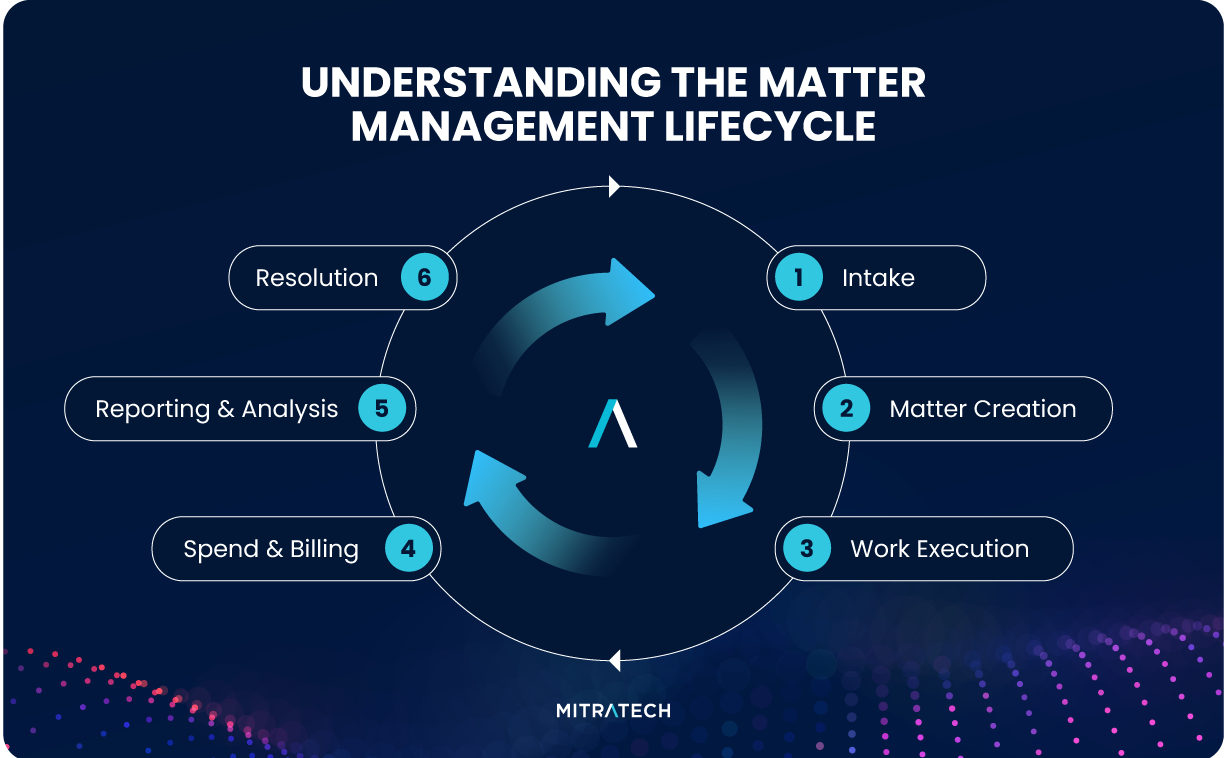
Matter management spans the full lifecycle of legal work — from intake to resolution — ensuring consistency and visibility at every stage.
Matter Management Lifecycle
| Stage | Description |
|---|---|
| Intake | Collect legal requests and required information |
| Matter Creation | Establish matter details, stakeholders, and scope |
| Work Execution | Manage tasks, documents, and workflows |
| Spend & Billing | Track invoices, budgets, and outside counsel performance |
| Reporting & Analysis | Generate insights on legal performance and spend |
| Resolution | Close matters and retain data for reporting and compliance |
This lifecycle supports end-to-end legal operations by connecting work, data, and decision-making in a single system.
Benefits of Matter Management Software
Matter management software enables legal teams to move from disconnected processes to a centralized, efficient, and data-driven operating model.
Key Benefits
- Centralized visibility: Single source of truth for all legal work
- Improved decision-making: Reporting and analytics support data-driven insights
- Enhanced collaboration: Better communication across legal teams and external partners
- Legal spend control: Insights into expenditures to help optimize budgets
- Compliance and risk management: Supports regulatory compliance and risk oversight
- Workflow efficiency: Automation of tasks to improve productivity
By centralizing matter, spend, and workflows, legal teams gain greater visibility, defensibility, and control.
Best Practices
To maximize the value of matter management, legal teams should focus on standardization, integration, and data quality.
Best Practices
- Centralize legal work: Maintain a single system for all matters
- Standardize processes: Ensure consistent workflows and task execution
- Integrate systems: Connect matter management with eBilling and reporting
- Leverage analytics: Use reporting to guide strategic decisions
- Improve collaboration: Enable communication across teams and partners
These practices help legal teams reduce manual effort, improve consistency, and support better outcomes.
A Quick Segway: How Matter Management Connects to eBilling and Legal Operations
Matter management is closely connected to eBilling and legal spend management. Together, they:
- Streamline the billing process and reduce errors
- Ensure compliance with billing guidelines
- Provide insights into legal expenditures and performance
This integration enables legal teams to manage both work and spend in a unified system, improving transparency and control across operations.
Frequently Asked Questions
What is a matter in legal operations?
A matter is any legal issue, case, or request that requires legal work, including litigation, contracts, or investigations.
Why is matter management important?
It provides visibility, control, and consistency across legal operations, helping teams manage risk and improve performance.
Who uses the software?
Corporate legal departments, legal operations professionals, and legal teams responsible for managing legal work.
How is matter management different from eBilling?
Matter management tracks legal work, while eBilling manages invoices and legal spend—often within the same system.