Choosing the right GRC software platform for global risk management depends on framework coverage, automation depth, integration flexibility, scalability, and support for continuous risk prioritization by likelihood and severity. This guide compares leading options so you can match the right platform to your organization's risk complexity and compliance needs.
GRC has evolved from a compliance checkbox function into a strategic advantage for organizations navigating complex, fast moving risk environments. Static, siloed tools have given way to integrated platforms that connect governance, risk, and compliance data across the enterprise in real time.
Today’s leading GRC platforms deliver four core capabilities:
- Continuous monitoring, real time visibility into control status and emerging threats
- Automated evidence collection, less manual work for audits and assessments
- Seamless integrations, connections across ERP, ITSM, HR, legal, and security systems
- Predictive analytics, AI supported risk trend analysis before incidents occur
Audit readiness: The state of having controls, documentation, and evidence prepared so audits can begin without delay. Continuous control monitoring (CCM): Automated, ongoing testing of controls to detect failures as they happen. Risk analytics: The use of data and scoring models to measure, compare, and prioritize risk.
Procurement priorities in 2025 now center on framework coverage such as SOX, SOC 2, ISO 27001, and GDPR, plus API connectivity and scalability for global operations.
Product features, capabilities, and positioning are accurate based on publicly available data as of July, 2026.
What's Inside:
What Is Global GRC Software?
Global GRC software is a platform that unifies governance, risk, and compliance activities across multiple business units, regions, and regulatory jurisdictions, rather than managing them separately by country or division. Core capabilities include a centralized risk register with consistent scoring across the enterprise, multi-framework support (SOX, SOC 2, ISO 27001, GDPR, and others), automated evidence collection, continuous control monitoring, workflow automation, and integrations across ERP, ITSM, HR, legal, and security systems.
What separates global GRC software from single-region or single-framework tools is scale: it needs to support multiple languages, multiple regulatory regimes operating at once, and a consolidated view of risk across business units so leadership sees one enterprise-wide picture instead of fragmented, region-by-region reporting.
Why Organizations Need Global GRC Software (vs. Non-Global GRC)
Non-global GRC tools are often built around a single framework, region, or business unit. That works fine for a single-market company, but it breaks down as soon as an organization operates across borders, subsidiaries, or multiple regulatory regimes at once. Global GRC software is built specifically to handle that added layer of complexity.
- Multiple regulatory regimes running simultaneously. A company operating in the U.S., EU, and APAC needs to track SOX, GDPR, and local data protection laws at the same time, not as separate, disconnected programs. Non-global tools typically require running parallel instances or manual workarounds to cover more than one jurisdiction.
- Inconsistent risk visibility across business units. Without a global platform, each region or subsidiary often keeps its own risk register and scoring method, so leadership can’t compare risk exposure across the business. Global GRC software applies one consistent scoring model enterprise-wide.
- Language and localization requirements. Distributed workforces need policies, attestations, and reporting available in local languages. Single-region tools rarely support this out of the box.
- Cross-border data residency and hosting requirements. Global operations often require flexible deployment (cloud, on-prem, or hybrid by region) to meet local data residency rules, something non-global platforms aren’t typically designed to accommodate.
- M&A and organizational growth. As companies acquire subsidiaries or expand into new markets, a global platform absorbs new business units and jurisdictions without requiring a new system per region. Non-global tools often can’t scale this way without significant rework.
- Consolidated audit reporting. Regulators and boards increasingly expect one defensible, enterprise-wide view of compliance posture. Global GRC software produces that in a single report; non-global tools force compliance teams to manually stitch together evidence from multiple disconnected systems.
Evaluation Criteria
We evaluate each platform using the following capability criteria:
- Framework coverage (SOX, SOC 2, ISO 27001, GDPR, and others)
- Workflow automation
- Continuous monitoring and control testing (CCM)
- Integration flexibility
- Deployment model
- AI and advanced analytics
- Scalability for global operations
- Risk prioritization by likelihood and severity
Our insights are based on publicly available product documentation, vendor websites, and industry comparison resources. Mitratech acknowledges that competitors may update their products or terms at any time. All trademarks, service marks, and company names are the property of their respective owners. Use of these names does not imply any affiliation with or endorsement by them.
The following vendor evaluations are listed in no particular order.
2026 GRC Global Software Vendors
1. Mitratech GRC Platform
Best for: Complex, multinational enterprises needing integrated, cross-domain risk management spanning ethics and compliance, enterprise risk, resilience, third-party oversight, and AI governance, across multiple regions and jurisdictions.
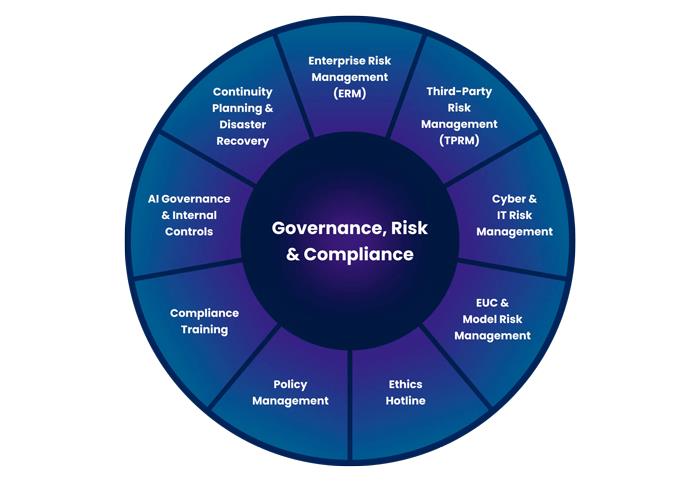
The Mitratech Global GRC Platform connects governance, risk, and compliance across the enterprise through a centralized point of access and intelligent analysis. Rather than consolidating every workflow into one rigid structure, it links Mitratech’s proven domain solutions together through intelligence, so organizations gain a broader view of risk without losing the depth built into each discipline.
Key Features:
- Centralized point of access connecting ethics and compliance, enterprise risk, resilience, third-party oversight, and AI governance in one platform
- ARIES™ AI agent, grounded in structured, tested APIs, that answers questions and generates reports by drawing on data across connected Mitratech products from a single login
- Opt-in AI design, teams choose when and where AI is used and can adjust at any time
- Built for multinational, multi-jurisdiction organizations, with regional regulatory expertise shaped by real-world practice
- End-to-end GRC coverage spanning policy, training, IT and cyber risk, AI governance, conflicts of interest, and board reporting
- Expanding visibility as more Mitratech tools are added, surfacing cross-domain trends and impacts while keeping data private, secure, and defensible
Why It Stands Out: Mitratech’s platform is built around connection rather than consolidation, preserving the expertise built into each GRC discipline while giving leadership a cross-functional view of risk. Deep regional regulatory understanding and support for multinational, multi-jurisdiction environments set it apart for organizations managing risk across borders. Trusted by organizations including Allianz, HDI, ScionHealth, and Norwegian Cruise Line.
Key Takeaway: Mitratech offers connected, not consolidated, GRC: full domain depth across ethics, risk, resilience, and compliance, unified through AI-driven intelligence and built for complex, multi-region organizations.
Explore Mitratech’s GRC Global Platform →
Request a Demo
2. ServiceNow IRM
Best for: Enterprises already using ServiceNow that want to extend risk and compliance automation across an ITSM centric environment. (Source: ServiceNow Integrated Risk Management)
ServiceNow GRC provides a unified suite for policy, risk, compliance, and audit management. It is especially effective for organizations that want workflow automation and real time controls testing inside an existing ServiceNow ecosystem. (Source: ServiceNow IRM; Continuous Monitoring)
Key Features:
- Integrated GRC suite (policy, risk, compliance, audit)
- Real time controls testing and continuous monitoring
- Audit workflow automation for evidence collection and scheduling
- ITSM native risk visibility linking incidents to the risk register
Key takeaway: ServiceNow GRC leverages existing ServiceNow investments to deliver seamless, enterprise wide risk automation.
3. MetricStream
Best for: Regulated industries that need broad framework coverage and deep configurability.
MetricStream is a configurable enterprise GRC platform with strong support for continuous control testing, unified risk and compliance workspaces, and global scalability. It is well suited to large programs that need extensive framework coverage. (Source: CCM; Compliance Management)
Key Features
- Continuous control testing and automated assessment
- Unified risk and compliance workspace for a consolidated view
- Broad framework coverage (SOX, Basel III, GDPR, ISO, HIPAA, etc.)
- Designed for enterprise scale programs across multiple business units and jurisdictions
Key takeaway: MetricStream’s configurability lets highly regulated enterprises tailor the platform to complex, multi framework requirements.
4. Archer
Best for: Large enterprises with complex governance needs and significant integration requirements.
RSA Archer uses a modular design that supports policy, compliance, audit, and IT risk workflows. Its customization and API interoperability make it useful for organizations that need to aggregate risk data across multiple systems. (Source: Archer Solutions; G2 Archer Reviews)
Key Features
- Modular architecture for selective capability deployment
- Deeply customizable workflows to match existing governance processes
- API interoperability and data feeds for pulling risk data from diverse source systems
- Integrations with external security and enterprise systems via connectors and APIs
Key takeaway: RSA Archer’s modular, API driven approach enables highly customized governance for intricate, multi layered enterprises.
5. OneTrust
Best for: Organizations with privacy first GRC needs and third party risk requirements. (Source: Privacy Management; Third Party Risk)
OneTrust focuses on privacy, security, and third party risk management. It is commonly used for GDPR, CCPA, and related compliance programs that require privacy impact assessments and regulatory content.
Key Features
- Privacy impact assessments (PIAs/DPIAs) aligned to GDPR Article 35
- Extensive regulatory content library (GDPR, CCPA, ISO 27701, etc.)
- Third party risk management with vendor questionnaires and continuous monitoring
- Fast program launch using out of the box templates
- Consent and preference management extending GRC into operational privacy
6. Optro
Best for: Finance and assurance teams that need fast audit management and SOX automation.
AuditBoard is a cloud first platform built for audit, SOX, and evidence automation. It helps teams streamline controls testing, automate evidence collection, and maintain current compliance status. (Source: Products; CrossComply)
Key Features
- Automated evidence collection via direct integrations
- Structured SOX workflow automation (control testing, sign offs, audit trail)
- Continuous controls monitoring for real time visibility between audit cycles
- Cross team collaboration workspaces for audit, risk, and compliance
Key takeaway: AuditBoard delivers rapid time to value for audit focused teams through cloud native automation and collaboration.
7. Vanta
Best for: Cloud native businesses, startups, and high growth tech companies needing rapid, automated compliance for SOC 2, ISO 27001, and HIPAA. (Source: Frameworks)
Vanta is a compliance automation platform engineered for speed. Its out of the box continuous monitoring integrates directly with cloud providers, SaaS tools, and development environments to gather evidence automatically.
Key Features
- Continuous monitoring with 200+ integrations for automated evidence collection
- Rapid deployment, SOC 2 or ISO 27001 programs can launch in weeks
- Framework coverage: SOC 2, ISO 27001, HIPAA, PCI DSS, GDPR, etc.
- Real time compliance dashboard with readiness scores and gap identification
Key takeaway: Vanta’s automated, cloud native approach compresses compliance timelines from months to weeks.
8. LogicGate Risk Cloud
Best for: Mid market enterprises that need customizable, no code risk and compliance workflows without heavy IT involvement.
LogicGate Risk Cloud revolves around a no code workflow engine that enables risk, compliance, and audit teams to build, modify, and iterate on processes without writing code. (Source)
Key Features
- Drag and drop no code workflow builder
- Configurable dashboards for risk views and reporting without developers
- Rapid deployment without lengthy implementation cycles
- Real time workflow modifications as risk processes evolve
- Structured task and process management with assignment, tracking, and escalation
Key takeaway: LogicGate’s no code environment empowers risk teams to adapt workflows instantly, eliminating IT bottlenecks.
9. NAVEX One
Best for: Enterprises needing a unified ethics, risk, and compliance platform that connects whistleblowing, policy, training, and third-party risk in one system.
NAVEX One is an AI powered GRC platform that consolidates speak-up, policy, training, disclosures, risk management, and third-party risk on one platform to reduce silos and reveal cross-program insights. It’s built to connect data across compliance functions rather than manage them as separate point tools. NAVEX
Key Features
- Unified GRC platform bringing whistleblowing, policy management, training, disclosures, and third-party risk into one system
- Regulatory expertise drawing from a customizable content library by region and industry, with requirements mapped to policies and updates triggered as regulations change NAVEX
- Global compliance coverage supporting laws, frameworks, and third-party screening tied to AML, KYC, and global whistleblowing requirements NAVEX
- AI powered trend analysis (Nira) connecting incident, policy, and risk data to surface patterns before they escalate
- Global hosting supported by localization and AI translations to help meet regulations across regions without heavy admin NAVEX
Key takeaway: NAVEX One’s strength is consolidation, unifying ethics, policy, training, and risk data that’s traditionally spread across disconnected point tools into one platform with cross-program reporting.
Conclusion
The GRC landscape in 2026 offers a spectrum of solutions, from highly configurable, enterprise grade platforms like Mitratech, MetricStream, and IBM OpenPages to agile, cloud native options such as Vanta and LogicGate. Selecting the right platform hinges on your organization’s size, regulatory footprint, existing technology stack, and the depth of automation required. Evaluate each solution against the five core factors, framework coverage, automation depth, integration flexibility, scalability, and continuous risk prioritization, to ensure a future proof investment that transforms compliance into a strategic advantage.
Why Mitratech GRC Platform Is a Strong Choice
Built for global, cross-enterprise GRC. The Mitratech Global GRC Platform connects governance, risk, and compliance across the enterprise through a centralized point of access and intelligent analysis, bringing together ethics and compliance, enterprise risk, resilience, third-party oversight, and AI governance in one place rather than managing each as a separate system.
Connected, not consolidated. Rather than forcing every workflow into one rigid structure, the platform links proven domain solutions together through intelligence, preserving the depth of each discipline while giving leadership a cross-functional view of risk across regions and business units.
Built for multinational, multi-jurisdiction organizations. The platform is designed around deep understanding of regional regulatory expectations and support for multinational, multi-jurisdiction environments, shaped by real-world practice rather than a single-market template.
AI grounded in real GRC data. ARIES™, Mitratech’s GRC AI agent, works across connected Mitratech products from one login, drawing on structured, tested APIs so responses trace back to source data teams can verify. AI is opt-in by design, teams choose when and where it’s used and can adjust at any time.
Deep domain expertise across the full GRC lifecycle. Coverage spans ethics and compliance, enterprise risk management, third-party risk, resilience and continuity, policy and training, IT and cyber risk, AI governance, conflicts of interest, and board reporting.
Expanding visibility as the ecosystem grows. As organizations add more Mitratech tools, visibility grows with it, surfacing trends and cross-domain impacts that stay hidden when data lives in silos, while keeping data private, secure, and defensible.
Backed by long-term expert partnership. Technology paired with specialists invested in outcomes, not just onboarding, trusted by organizations including Allianz, HDI, ScionHealth, and Norwegian Cruise Line.
Why Choose Mitratech GRC Platform?
- Centralized access and intelligent analysis connecting governance, risk, and compliance across the enterprise, not siloed by region or business unit
- Connected, not consolidated: full domain depth across ethics, risk, resilience, and third-party oversight, linked through intelligence rather than flattened into one generic workflow
- Built for multinational, multi-jurisdiction organizations, with regional regulatory expertise shaped by real-world practice
- ARIES™ AI agent grounded in verifiable, structured data, opt-in and adjustable at any time
- End-to-end GRC coverage: policy, training, IT and cyber, AI governance, conflicts of interest, and board reporting
- Visibility that expands as your Mitratech ecosystem grows, without disrupting the workflows already in place
- Long-term expert partnership backing the technology, trusted by global organizations across financial services, healthcare, and beyond
"Mitratech listened. They provided recommendations to facilitate our goals and engaged in several cross-functional meetings to ensure they understood our environment and priorities. The responsiveness and reliability have been the difference-maker in this vendor relationship. We feel that they understand our business is 24/7... and they take issue-resolution seriously."


Why Choose Mitratech GRC Platform?
- Platform model: Connected, not consolidated, domain depth preserved, linked through intelligence
- AI: ARIES™ GRC AI agent, opt-in by design, grounded in structured, verifiable data
- Coverage: Ethics and compliance, enterprise risk, resilience, third-party oversight, IT and cyber risk, AI governance, conflicts of interest, board reporting
- Built for: Multinational, multi-jurisdiction organizations with regional regulatory expertise
- Access: Single centralized login across connected Mitratech products
- Scalability: Visibility expands as more Mitratech tools are added to the ecosystem
- Trusted by: Allianz, HDI, ScionHealth, Norwegian Cruise Line, and other global organizations
- Support model: Long-term expert partnership, not just onboarding
How to Choose Global GRC Software
Start by mapping your regulatory footprint: which frameworks apply in each country or region you operate in, and where those requirements overlap or conflict. Inventory the risk and compliance tools currently in use across business units, since global organizations often discover they’re running several disconnected systems by region rather than one consolidated platform. Identify where a unified system would close visibility gaps or eliminate redundant, region-specific tools.
Compare trade-offs directly: broad, multi-framework coverage versus deep specialization in a single framework; cloud-only speed versus hybrid or on-premises deployment for data residency requirements; and a single global risk register versus per-region scoring that’s harder to compare at the leadership level. Validate whether a platform supports the languages, jurisdictions, and business units your organization actually operates in today, and whether it can absorb new regions as the company grows through expansion or M&A, not just the regions it covers at signature.
A focused pilot in one region or business unit can validate reporting consistency, integration depth, and adoption before a global rollout. Prioritize platforms that give you one defensible, enterprise-wide view of risk and compliance posture, since fragmented regional reporting is the exact problem global GRC software is meant to solve.
Before selecting a platform, validate it against these questions:
- Does the platform support the specific regulatory frameworks required in every country or region you operate in?
- What is the data residency model, and does it meet local requirements for each jurisdiction?
- Can risk be scored consistently across business units, or does each region require separate configuration?
- What languages does the platform support for policies, attestations, and reporting?
- Can the platform absorb new regions or business units without requiring a new instance or system?
- What deployment models are available (cloud, hybrid, on-premises), and do they match your infrastructure requirements by region?
- How does the platform consolidate reporting for board or regulator level visibility across the entire organization?
Frequently Asked Questions
What criteria should I use to evaluate GRC software platforms?
How does automation improve risk management in GRC platforms?
What are key features to look for in a global risk management solution?
How can a risk prioritization matrix help my organization?
Sources
Analyst & Industry Research
- G2. (n.d.). GRC software reviews. Retrieved July 2026, from https://www.g2.com/
- Gartner. (n.d.). Governance, risk, and compliance market research. Retrieved July 2026, from https://www.gartner.com/
- Forrester Research. (n.d.). Governance, risk, and compliance platforms. Retrieved July 2026, from https://www.forrester.com/
Vendor Product Pages
- Mitratech. (n.d.). GRC Platform. Retrieved July 2026, from https://mitratech.com/products/grc-platform/
- ServiceNow. (n.d.). Integrated Risk Management. Retrieved July 2026, from https://www.servicenow.com/
- MetricStream. (n.d.). GRC software solutions. Retrieved July 2026, from https://www.metricstream.com/
- RSA Archer. (n.d.). Archer Solutions. Retrieved July 2026, from https://www.archerirm.com/
- OneTrust. (n.d.). Privacy and third party risk management. Retrieved July 2026, from https://www.onetrust.com/
- AuditBoard. (n.d.). CrossComply. Retrieved July 2026, from https://www.auditboard.com/
- Vanta. (n.d.). Compliance automation. Retrieved July 2026, from https://www.vanta.com/
- LogicGate. (n.d.). Risk Cloud. Retrieved July 2026, from https://www.logicgate.com/
- IBM. (n.d.). OpenPages. Retrieved July 2026, from https://www.ibm.com/products/openpages
Industry Standards & Regulatory Frameworks
- U.S. Securities and Exchange Commission. (n.d.). The Sarbanes-Oxley Act of 2002. Retrieved July 2026, from https://www.sec.gov/spotlight/sarbanes-oxley.htm
- AICPA. (n.d.). SOC 2 reporting. Retrieved July 2026, from https://www.aicpa-cima.com/
- International Organization for Standardization. (2022). ISO/IEC 27001:2022. Retrieved July 2026, from https://www.iso.org/isoiec-27001-information-security.html
- European Union. (2016). Regulation (EU) 2016/679 (GDPR). Retrieved July 2026, from https://gdpr.eu/
Compliance Disclaimer
Note: No fabricated statistics, invented analyst rankings, or unattributed claims are included in this article.
Product descriptions are based on publicly available vendor documentation and industry reports. Features and capabilities may change over time. This article does not constitute an endorsement of any vendor or product. Organizations should conduct their own due diligence, including product demonstrations and reference checks, before making purchasing decisions. The cited regulatory guidance is provided for informational context only and does not constitute legal or compliance advice.
Evaluation Criteria Definitions
| Criteria | Description |
|---|---|
| Framework Coverage | Breadth of supported regulatory and industry frameworks (e.g., SOX, SOC 2, ISO 27001, GDPR) |
| Workflow Automation | Automated routing for approvals, escalations, and remediation tracking |
| Continuous Monitoring / CCM | Automated, ongoing testing of controls to detect failures as they happen |
| Integration Flexibility | Depth and ease of connecting to ERP, ITSM, HR, legal, and security systems via API |
| Deployment Model | Support for cloud, on-premises, or hybrid deployment |
| AI / Advanced Analytics | Use of AI-supported risk trend analysis, predictive insights, and anomaly detection |
| Scalability for Global Operations | Ability to support multiple regions, business units, languages, and regulatory regimes in one system |
| Risk Prioritization | Use of data and scoring models to measure, compare, and prioritize risk by likelihood and severity |