The ROI of Document Automation: Benefits, Business Case, and Real-World Results
A practical guide for legal, finance, operations, and IT leaders making the case for enterprise-grade document automation.
Co-authored by Mitratech and Gene Turner, Managing Director, LawHawk
Mitratech HotDocs reduces document creation time by 75–90%… and that’s before you account for what automation does to compliance risk, contract outcomes, and headcount planning. This guide gives you the complete framework for calculating and maximizing the return on a document automation investment, drawn from real client outcomes across legal, financial services, insurance, and enterprise operations.
If you’re building a business case, evaluating platforms, or trying to understand whether automation can actually scale with your organization, start here. P
But please note: The ROI models and examples in this guide assume the use of a mature, enterprise-class solution such as Mitratech Document Automation (HotDocs). Simpler or entry-level tools may not deliver comparable results due to limitations in scalability, configurability, and integration depth.
Why Most Document Automation ROI Calculations Miss the Mark
Many organizations underestimate the value of document automation because they measure it too narrowly. Traditional ROI analyses focus on time savings in drafting and stop there, missing the downstream value that represents the majority of the return.
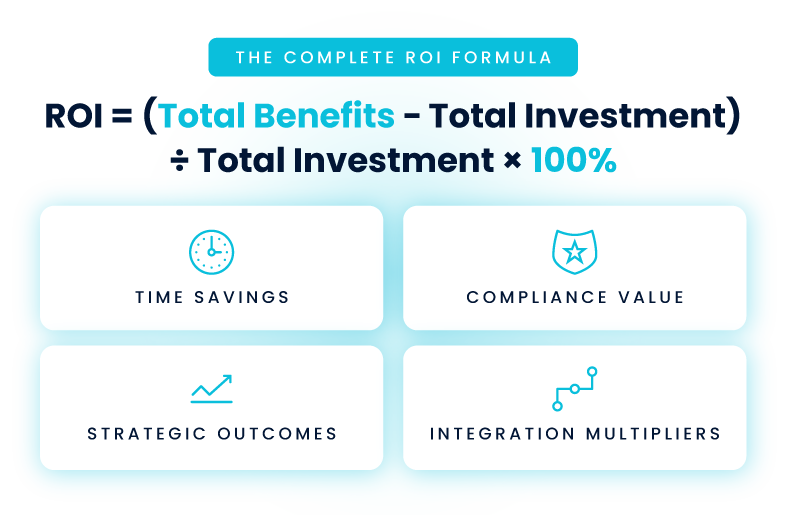
A credible ROI analysis must capture four categories of value:
- Direct time and cost savings: drafting time, review time, approval cycles, rework
- Risk and compliance value: error prevention, penalty avoidance, audit readiness
- Strategic and operational outcomes: deal velocity, scalability, key-person risk reduction
- Integration multipliers: how automation compounds the ROI of adjacent investments in workflow, case management, and AI
The fundamental formula is straightforward:
ROI = (Total Benefits − Total Investment) ÷ Total Investment × 100%
The calculation looks simple. Getting each component right requires a structured approach to both benefits and costs, which the rest of this guide walks through.
No calculator can capture every variable in your environment, but Mitratech’s ROI calculator is designed to give you a clear, fact-based starting point for building a more complete business case.
Step 1: Map Your Current State Before You Calculate Anything
A business case built on assumptions rather than data rarely survives executive scrutiny. Before modeling ROI, document where the inefficiency actually lives.
Document inventory
List your highest-volume document types. For each one, measure: how many are created annually, how long each takes to draft, review, and approve, how often errors require rework, and which staff are involved at each stage.
Step 2: Calculate Time Savings
Time savings are the most immediate and measurable ROI driver. Even on a standalone basis, document automation reduces drafting time by 75–90%, and the value extends well beyond the person doing the drafting.
How to Calculate Your Time Savings
- Identify your highest-volume document types, including NDAs, MSAs, employment contracts, loan documents, and engagement letters
- Measure the average time currently spent per document across drafting, review, and approval
- Apply the automation reduction benchmark: 75–90% reduction in drafting time, with additional savings in review and approval as error rates fall
- Multiply the time saved by the fully loaded hourly cost of the staff involved
- Factor in downstream time savings, like legal and compliance teams shifting from manual review to dashboard-based oversight
What this looks like in practice
The value extends across the organization, not just to the person who used to draft manually. Clients, procurement teams, finance, and leadership all benefit when routine processes move faster with fewer errors.
Real client outcomes:
- A top 10 global financial services provider cut document completion time by 90%, reduced templates from 600 to 75, and achieved £4.8M (~$6M USD) in annual savings with 15% fewer errors
- A professional services firm reduced document creation from 4 days to 2 hours
- A real estate client increased valuation report volume by 20% without new hires
- A SaaS company reduced template update times from 6 weeks to 30 seconds

Step 3: Quantify Risk Reduction and Compliance Value
In highly regulated sectors, compliance value often exceeds all other ROI factors. The right document automation platform embeds compliance into the process itself, ensuring policies are followed by design rather than by chance.
The Cost of Getting It Wrong
Research by World Commerce & Contracting shows that poor contracting practices erode an average of 8.6% of contract value. Automation addresses this directly by dynamically generating only the relevant clauses from a single, approved source of truth, eliminating bracketed alternatives, outdated terms, and human editing errors.
Four Measurable Compliance Benefits
-
Audit Readiness.
Automated workflows create a timestamped, tamper-evident record of every action taken across the document lifecycle. When courts or regulators ask for evidence of process, that record exists and is defensible. Manual methods (like periodic surveys, self-certifications, ad hoc reviews) cannot produce the same evidence.
-
Penalty Avoidance.
Real-time validation flags incomplete or noncompliant inputs before a document is generated. Mitratech HotDocs Advance requires mandatory fields to be completed before assembly proceeds, eliminating the most common source of post-execution disputes.
-
Rapid Regulatory Updates.
When a regulation changes or a template needs updating, the fix deploys instantly across all future documents. Every user generates from the current approved version; there is no version drift, no outdated copies on local drives, no documents produced from last year’s template.
-
Policy Enforcement at Scale.
Automation operationalizes your compliance framework. Approved clauses are locked. Business rules determine which clauses apply to which scenarios. Users can only select policy-compliant options. The simplest way to prevent a compliance mistake is to make the wrong choice impossible to select.
How to Quantify This in Your Business Case
For each document type in scope, estimate: the frequency of compliance errors under the current process, the average cost per error (staff time to correct, plus any external cost or risk exposure), and the reduction in error frequency that automation delivers. Layer in the value of audit readiness as a risk mitigation figure: what is the cost of being unable to demonstrate reasonable preservation or compliance steps if challenged?

Before You Calculate ROI, Know Where You Stand
Our buyer's guide walks you through what to assess before choosing a document automation platform.
Step 4: Calculate the Value of Better Contract Outcomes
Document quality has a direct impact on business outcomes that most ROI models ignore entirely.
A well-designed contract defines every deliverable, milestone, responsibility, and payment term with precision. Manual templates compromise on this. They rely on bracketed options and user edits, which introduce inconsistency, require more negotiation time, and produce contracts that are harder to enforce.
Enterprise-grade automation like Mitratech HotDocs makes precision achievable without sacrificing speed. The structured data captured through automated questionnaires — who is responsible, what standards apply, when deliverables are due, how fees are calculated — flows directly into the document with no manual re-entry.
The Downstream Effect on Deal Velocity
When contracts are produced immediately after a negotiation, accurately reflecting the agreed terms, both parties are more likely to sign promptly. Delays give stakeholders time to reconsider, introduce new edits, or deprioritize the deal. One construction client routinely finalized agreements on the same day as negotiation, allowing them to order materials and schedule crews without delay.
The structured data captured during document generation also creates a direct pipeline from creation to contract management, eliminating the need for expensive AI extraction tools to pull terms from third-party documents, and populating downstream systems with 100% accuracy.
Put Real Numbers Behind Your Business Case
Use our interactive tool to estimate the time and cost savings document automation delivers for your team.
Step 5: Factor In Scalability and Headcount Savings
Without automation, document production scales linearly with headcount. If work doubles, teams need to grow. Automation breaks that relationship.
The Kāinga Ora Example
Kāinga Ora, New Zealand’s social housing provider, reviewed its legal workflows and projected it would need eight additional contract facilitators to meet rising demand. After implementing document automation, it cut that number in half — requiring only four additional hires. As their legal leader noted:
“The financial saving that comes from needing four less FTE is significant. There is the combined salary cost of around $300,000 and the indirect costs associated with staff of around a further $300,000; and that is only in one area of Kāinga Ora, and one process.”
That saving ($600,000 from one process, in one area of one organization) illustrates how quickly automation ROI compounds when applied at scale.
How to Model Headcount Savings
Project your document volume growth over the next two to three years. Estimate how many additional FTEs would be required to meet that volume under your current manual process. Calculate the fully loaded cost of those FTEs: salary, benefits, office, onboarding. That avoided headcount cost is a direct input to your ROI model, even if you never needed to make those hires.
Step 6: Include Integration Multipliers
Document automation amplifies the ROI of adjacent technology investments. When connected to workflow, case management, e-signature, or CRM systems, it becomes a key enabler of process transformation rather than a standalone efficiency tool.
For Mitratech clients, this compounding value is explicit. Mitratech HotDocs integrates natively with:
- Mitratech CaseCloud™ (case management) — automated document generation triggered by case events
- TeamConnect (matter management) — documents generated directly from matter data, no re-entry
- TAP (workflow automation) — approval routing built into document generation workflows
- Third-party tools including iManage, Salesforce, Microsoft 365, SharePoint, and Power Automate
The principle applies even without new investment. Many organizations already use Microsoft 365 or SharePoint. Connected to advanced automation, those existing tools deliver exponentially higher value.
What integration ROI looks like
When automation pulls structured data directly from existing systems, it eliminates entire layers of manual effort — not just drafting, but the data collection, verification, and re-entry that precedes it. When completed documents are automatically stored back into the source system with consistent metadata, organizations gain long-term accessibility and compliance that few manual processes maintain reliably.
A top 10 global law firm saved 10 hours per document template — equivalent to £2.8M (~$3.6M USD) in annual savings — largely through the elimination of manual data handling upstream and downstream of drafting.

Document Automation ROI by Sector
The following outcomes are drawn from real Mitratech HotDocs client deployments.
Banking and Financial Services
A top 10 global financial services provider implemented HotDocs across its highest-volume document types. Results: 90% faster document completion, templates reduced from 600 to 75, £4.8M (~$6M USD) in annual savings, 15% fewer errors, and consistent global compliance across jurisdictions. The primary drivers were faster time to cash on executed agreements and a significant reduction in rework and compliance review overhead.
Global banks of all sizes rely on Mitratech HotDocs to generate complex loan and security documents internally, with greater consistency and speed than traditional outsourcing. For lenders, this also reduces the cost passed to borrowers, improving competitiveness on transaction volume.
Is AI a Better Alternative to Document Automation?
It’s a question every technology buyer asks, and the answer is that they are not alternatives. They are complementary.
Document automation is mature, proven, and deterministic. It operates on approved templates using fixed logical rules, meaning it produces 0% hallucinations, never generates invented content, and always delivers consistent, auditable outputs. Any change to a generated document can be verified instantly against the base template using a redline comparison… something generative AI cannot provide, because it produces different outputs each time.
AI adds adaptability that automation cannot. When used together, they form a more complete legal technology stack:
Template creation. AI tools can accelerate template drafting and updates; a long-delayed template project can often be completed in a day using contract AI to extract and structure existing clauses.
Template automation. New AI functionality can review templates and automatically create many of the automation components required to get an initial working solution, compressing implementation timelines.
Advanced drafting. For complex matters, automation generates the first draft while AI suggests nuanced clauses from a given playbook or checks language against your risk thresholds.
Negotiation. Once automation produces the baseline document, AI can assist in redlining, comparison, and negotiation on top of that structured foundation.
The practical implication: investing in document automation now doesn’t limit your AI options later. It creates the structured data foundation that makes AI more effective when you’re ready to deploy it.
Most Compliance Risks Start With the Same Mistakes
See the 10 most common documentation errors — and exactly where automation closes the gap. Button: See the 10 Mistakes
Pre-Implementation Checklist: What to Measure Before You Begin
A credible ROI model requires a documented baseline. Use this checklist to structure your pre-implementation assessment.
Document Inventory
- List all document types in scope with annual creation volumes
- Measure average drafting, review, and approval time per document type
- Record current error rate and rework frequency
- Identify which staff roles are involved at each stage
Frequently Asked Questions

How can I speed up document production without hiring more staff?
Mitratech HotDocs reduces document creation time by 75–90% without adding headcount. By converting your highest-volume documents into intelligent templates and automating data population from existing systems, teams produce the same output with existing staff. Kāinga Ora cut a projected eight additional hires to four after implementation, saving over $600,000 in one process area alone.
What's the ROI of implementing document automation?
ROI = (Total Benefits − Total Investment) ÷ Total Investment × 100%. Benefits span time savings (75–90% drafting reduction), risk reduction (poor contracting practices erode an average of 8.6% of contract value), compliance cost avoidance, and scalability gains. A top 10 global financial services provider achieved $6M USD in annual savings. The strongest ROI cases capture all four categories — not just drafting efficiency.
How can I automate the creation of repetitive legal documents?
Mitratech HotDocs converts frequently used documents into intelligent templates with conditional logic and guided questionnaires. Users answer structured questions once and the system generates a complete, compliant document — pulling data from existing systems without manual re-entry. Document packages that previously took hours to assemble are completed in minutes with no drafting required.
What's the best way to generate contracts without starting from scratch each time?
Build master templates for your highest-volume contract types — NDAs, MSAs, engagement letters, loan documents — with variable fields connected to your existing data sources. Mitratech HotDocs populates those fields automatically at generation, applying conditional logic to include only the relevant clauses for each scenario. The structured data captured also flows downstream into contract management and payment systems with 100% accuracy.
How do I ensure document accuracy and compliance automatically?
Mitratech HotDocs embeds compliance into document creation by enforcing approved clauses, requiring real-time validation of mandatory fields, and preventing generation of incomplete or noncompliant documents. Every output follows the same standards regardless of who creates it. HotDocs Advance maintains full version history and provides analytics to flag any noncompliant document creation before it becomes a risk.
What tools help maintain version control for automated documents?
Mitratech HotDocs Advance maintains a complete template version history and ensures every user generates from the current approved version — there is no version drift, no outdated local copies, and no documents produced from superseded templates. When a template is updated, the change deploys instantly and universally. Analytics track adoption by user and business unit, allowing corrective action before noncompliance escalates.
What's the easiest way to create templates for legal agreements?
Mitratech HotDocs uses no-code configuration so subject matter experts — not developers — build and maintain document templates. Business rules, clause libraries, conditional logic, and approval workflows are configured through an intuitive interface. An estate planning firm reported completing a long-delayed template project in a single day using the AI-assisted template creation functionality in HotDocs Advance.
How do I reduce time spent on document drafting and formatting?
Template-based document automation eliminates manual drafting by generating complete, formatted documents from structured inputs. Mitratech HotDocs clients report 75–90% reduction in drafting time. The “final 20%” of complex documents — the conditional clauses, variable fee structures, and jurisdiction-specific terms that previously required senior review — are handled by the automation logic, not by a lawyer editing a template.
How does document automation work with AI?
They are complementary, not competing. Document automation provides zero-hallucination, template-based precision — producing consistent, approved outputs every time. AI adds speed and adaptability: accelerating template creation, suggesting nuanced clauses during negotiation, and assisting with redlining on top of the automation baseline. Mitratech HotDocs integrates both, allowing teams to deploy AI where it adds value without sacrificing the audit trail and deterministic accuracy that automation provides.
Why invest in an enterprise-grade platform rather than a lower-cost alternative?
A lower-cost platform that cannot manage organizational complexity or scale will ultimately cost far more in rework, failed adoption, and missed opportunity than a solution that delivers consistent results from day one. Real ROI requires accuracy, compliance, and process transformation, not just time savings. Mitratech HotDocs is one of only three Tier 1-rated document automation platforms according to LegalTech Hub, recognized for robust feature sets, product maturity, and market stability.
Built for the Way Law Firms Actually Work
See how firms of every size use Mitratech HotDocs to automate high-volume legal documents without sacrificing accuracy.
Take the First Step
Document automation ROI compounds over time. Each month of delay has a measurable cost — both the inefficiency that continues and the competitive advantage that accrues to teams that have already automated.
The right starting point is a realistic baseline. Mitratech’s ROI Calculator gives you a fact-based estimate you can refine with your own numbers and present to stakeholders with confidence.
Calculate your ROI → (link to ROI calculator)
Explore → Mitratech HotDocs
About the Authors
Mitratech is a proven, global compliance and automation solutions partner for legal, risk, compliance, and HR professionals. Mitratech serves over 28,000 organizations worldwide across more than 160 countries. mitratech.com
Gene Turner is the Managing Director of LawHawk, a global leader in leveraging Mitratech HotDocs to streamline and automate legal and business processes. Before founding LawHawk, Gene was a Corporate & Finance Partner at leading New Zealand law firm Buddle Findlay. He is a Fellow of World Commerce & Contracting and has served on the Advisory Board of the College of Law’s Centre for Legal Innovation since 2017. LawHawk has earned World Commerce & Contracting Awards for Operational Improvement in both 2019 and 2021.

©2026 Mitratech, Inc. All rights reserved.

©2026 Mitratech, Inc. All rights reserved.